
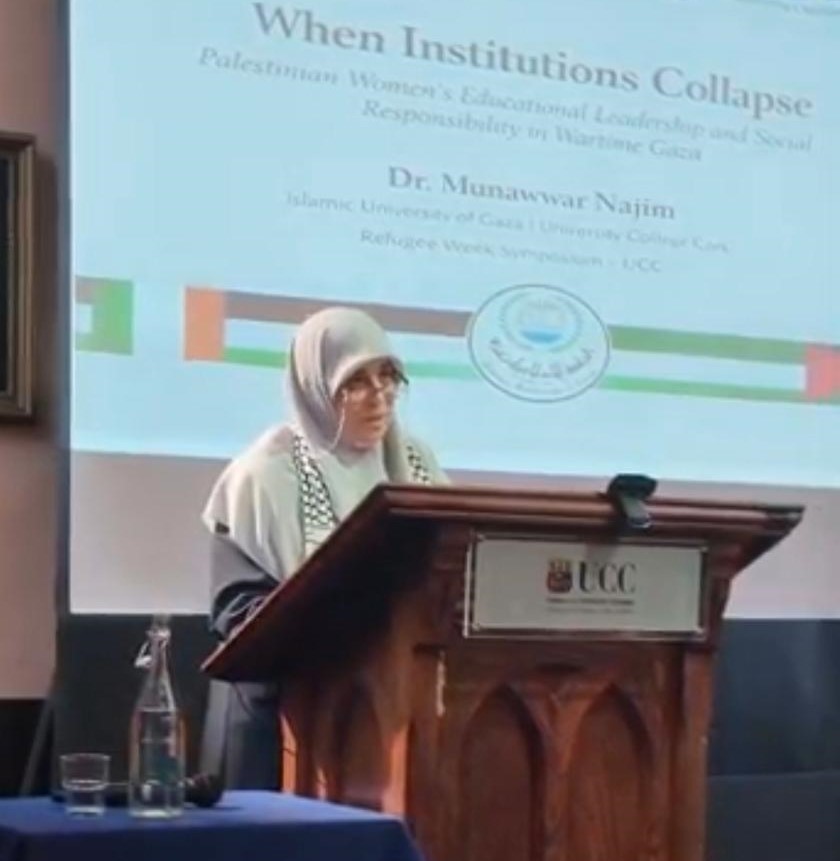
Dr Monowar Najim, a lecturer at Islamic University of Gaza (IUG), has participated in University College Cork’s (UCC) Refugee Week Symposium. The event, held in the Aula Maxima, was themed: “Asylum, Migration and Community – Bridging Research, Advocacy and Activism through Creative and Socially Engaged Research”.
Dr Najim presented a scientific paper titled: “Resilience in Crisis: The Role of Palestinian Women in Social Responsibility and Educational Leadership During the 2023–2025 War ; An Autoethnographic Perspective.”
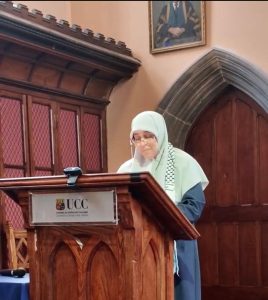
During her address, Dr Najim detailed the reality of higher education in the Gaza Strip during the war. She outlined the vast challenges faced by universities, including the destruction of campuses, the suspension of academic operations, and the displacement of students and faculty members, which led to the near-total collapse of institutional infrastructure. Dr Najim also highlighted the efforts made to ensure educational continuity, maintain academic communication, and facilitate postgraduate thesis defences under these extraordinary circumstances.
The research paper utilised an autoethnographic methodology as an analytical framework to generate knowledge from lived experience, challenging traditional theories of leadership in contexts of war and institutional collapse. She argued that leadership and responsibility during crises are not confined to formal positions, but are demonstrated through daily, ethical practices centred on care and sustaining community.
Her presentation specifically highlighted:
-
The establishment of alternative educational spaces: Ensuring that learning continued despite displacement and active threats.
-
Sustaining academic supervision: Successfully managing and conducting master’s thesis examinations during the conflict.
-
Redefining feminist leadership: Examining leadership as an active, community-driven practice in times of extreme vulnerability.
This participation underscores the ongoing presence of the Islamic University of Gaza in international academic forums, its contribution to providing documented, firsthand insights into higher education in Gaza, and its role in enriching global dialogue on leadership, education, and epistemic justice during times of conflict.