
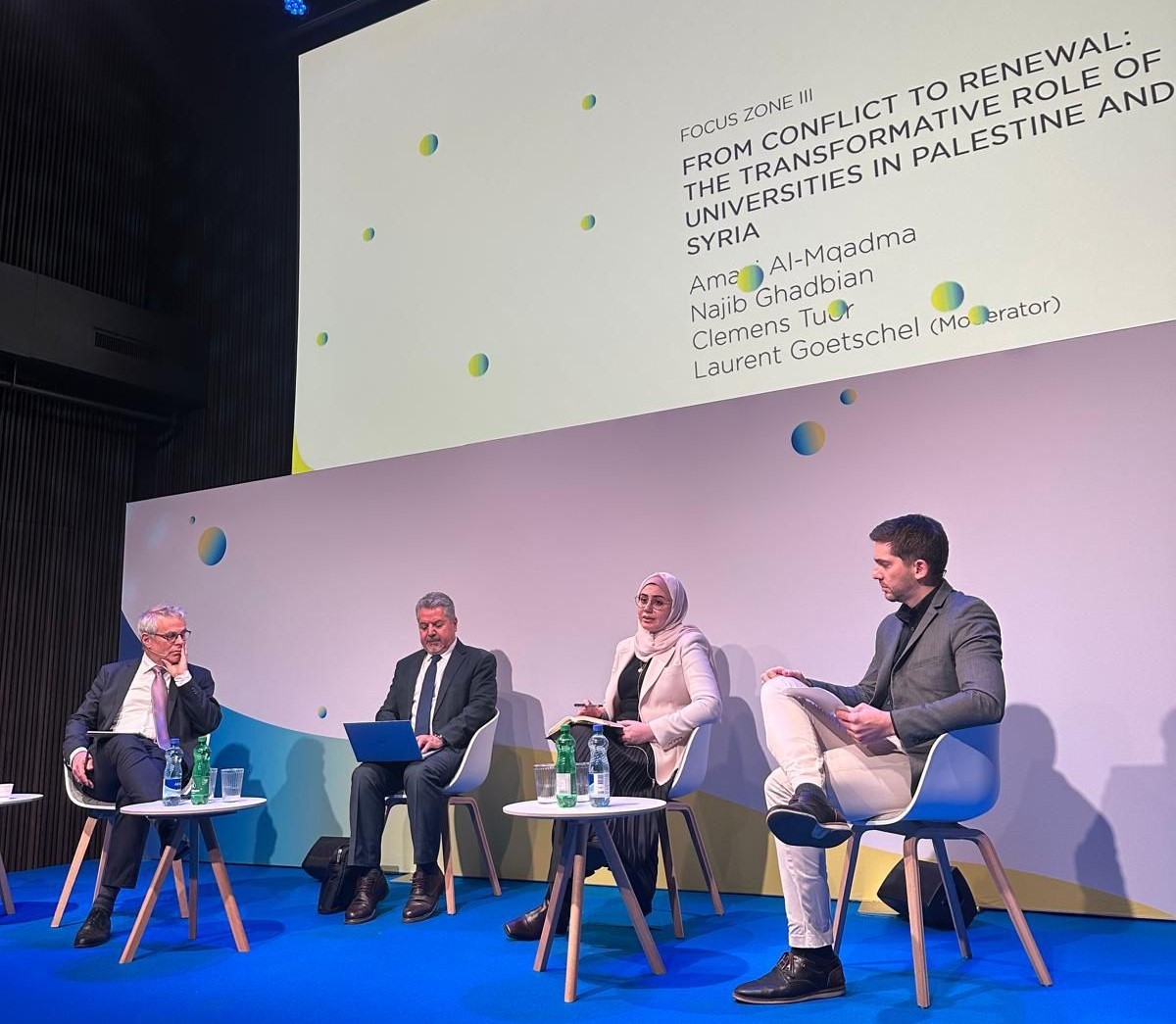
Islamic University of Gaza (IUG) has participated in the 10th edition of the Basel Peace Forum, held in Basel, Switzerland, on 23 January 2026. The event drew wide-ranging participation from diplomatic delegations, institutional heads, human rights activists, political researchers, and peacebuilders, alongside academics representing various global universities.
Eng. Amani Al-Maqadma, Head of External Relations at the Islamic University of Gaza, represented the institution as a keynote speaker in a panel session titled: “From Conflict to Renewal: The Transformative Role of Universities in Palestine and Syria”.
During her address, Eng. Al-Maqadma highlighted the profound challenges confronting the Islamic University and fellow higher education institutions in the Gaza Strip. She emphasised that these obstacles cannot be understood in isolation from their historical and political context, describing them not as routine operational difficulties, but as the struggles of a “survivor” enduring war and academic destruction.
Eng. Al-Maqadma noted that universities in Gaza are currently facing a complex series of unprecedented challenges, most notably:
- The near-total destruction of educational infrastructure: This includes the destruction of 19 buildings, including the Gaza Strip’s largest library, scientific laboratories, lecture halls, computer labs, and the Faculty of Medicine.
- Psychological distress and trauma: Severe psychological impacts affecting students and academics alike, resulting from loss, displacement, destruction, and the harsh realities of displacement camps.
- Sustained violence and insecurity.
- E-learning impediments: Digital education is severely hindered by continuous power outages and internet disruptions.
- The total destruction of specialized laboratories: Particularly those serving the health and engineering faculties.
- Academic isolation: Institutional barriers that prevent academics from contributing effectively to global knowledge production, despite their use of alternative technologies.
- Financial sustainability crises: A vast majority of students are unable to afford tuition fees due to economic collapse. This directly impacts the operational capacity of the Islamic University and other institutions that rely on tuition fees to sustain their academic mandates.
Eng. Al-Maqadma further explained that the acute financial crisis has left universities unable to meet salary obligations for staff and academics. This has placed immense pressure on educational institutions, threatening their structural stability and the continuity of their educational mission in the absence of sustainable funding and resources.
The session featured an extensive discussion comparing the contexts of Syria and the Gaza Strip. Eng. Al-Maqadma stressed the pivotal role academic institutions play in preserving societies during conflicts and disasters. She called upon international partners and donors to back universities that have remained resilient before and during the war, highlighting the urgent need for resources to support both students and academic faculty.
Concluding her remarks, Eng. Al-Maqadma affirmed that for Palestinians, education is not merely a means of acquiring knowledge, but an act of existence and resilience; a vital tool for protecting the Palestinian people, their identity, and their future.