
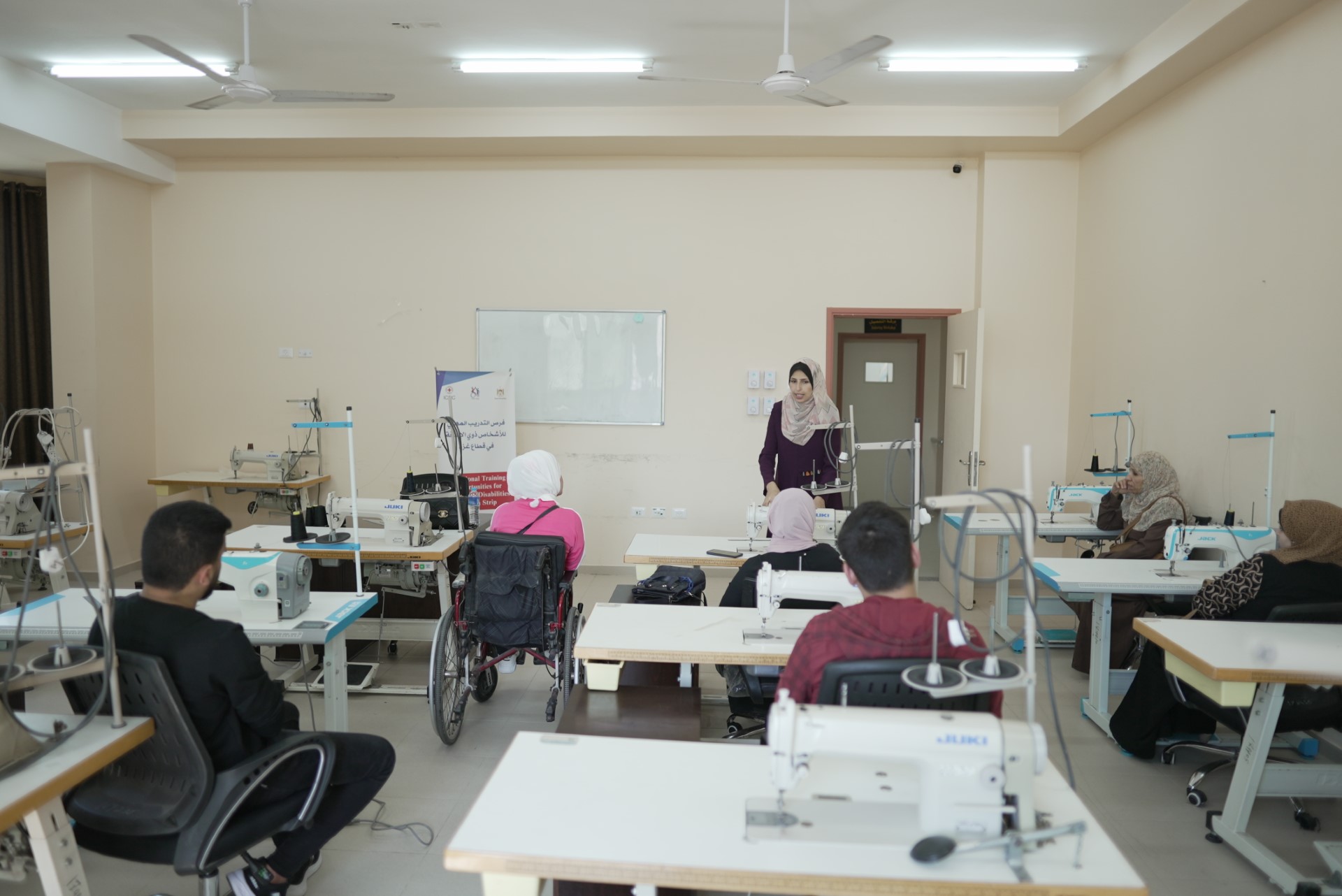
In partnership with the International Committee of the Red Cross (ICRC) and the Palestinian Ministry of Labor, Irade Center for Rehabilitation and Vocational Training at the Islamic University of Gaza has embarked on a project for people with disabilities. The project aims to develop the capacities of men and women with disabilities in the Gaza Strip, promoting their social integration and improving their labor market opportunities.
The project plan includes a set of specialized vocational training courses for people with disabilities. Forty participants will be trained during the five-month project in different vocational disciplines to provide them with the necessary practical experience and skills.
Project Implementation Phase
During the first phase, the candidates for training attended career guidance sessions that led them to the specializations that suited their desire, health status, and ability to learn. Later, a specialized committee, including representatives of the International Committee of the Red Cross, the Palestinian Ministry of Labor, and Irade, held interviews to select forty candidates to receive the training.
Following the selection process, Irade Center kicked off six vocational training courses in the fields of audio production, sewing, electric wiring, solar power, smart device programming, appliance maintenance, and carpentry.
In order to ensure efficiency and profitability, IUG has enlisted experienced trainers who specialize in the relevant fields. The Irade Center boasts fully equipped laboratories and teaching aids to facilitate learning. Additionally, ICRC has provided transportation to enable beneficiaries to conveniently access the Irade Center from their place of residence.

Project Close
The completion of vocational training will provide beneficiaries with the opportunity to kickstart their own projects through entrepreneurship courses. These courses aim to instill a culture of self-employment, offering guidance and support to create personalized action plans.
The completion of vocational training will provide beneficiaries with the opportunity to kickstart their own projects through entrepreneurship courses. These courses aim to instill a culture of self-employment, offering guidance and support to create personalized action plans. This initiative means to elevate the skills and knowledge of individuals, which will ultimately lead to the growth and success of their communities.
