
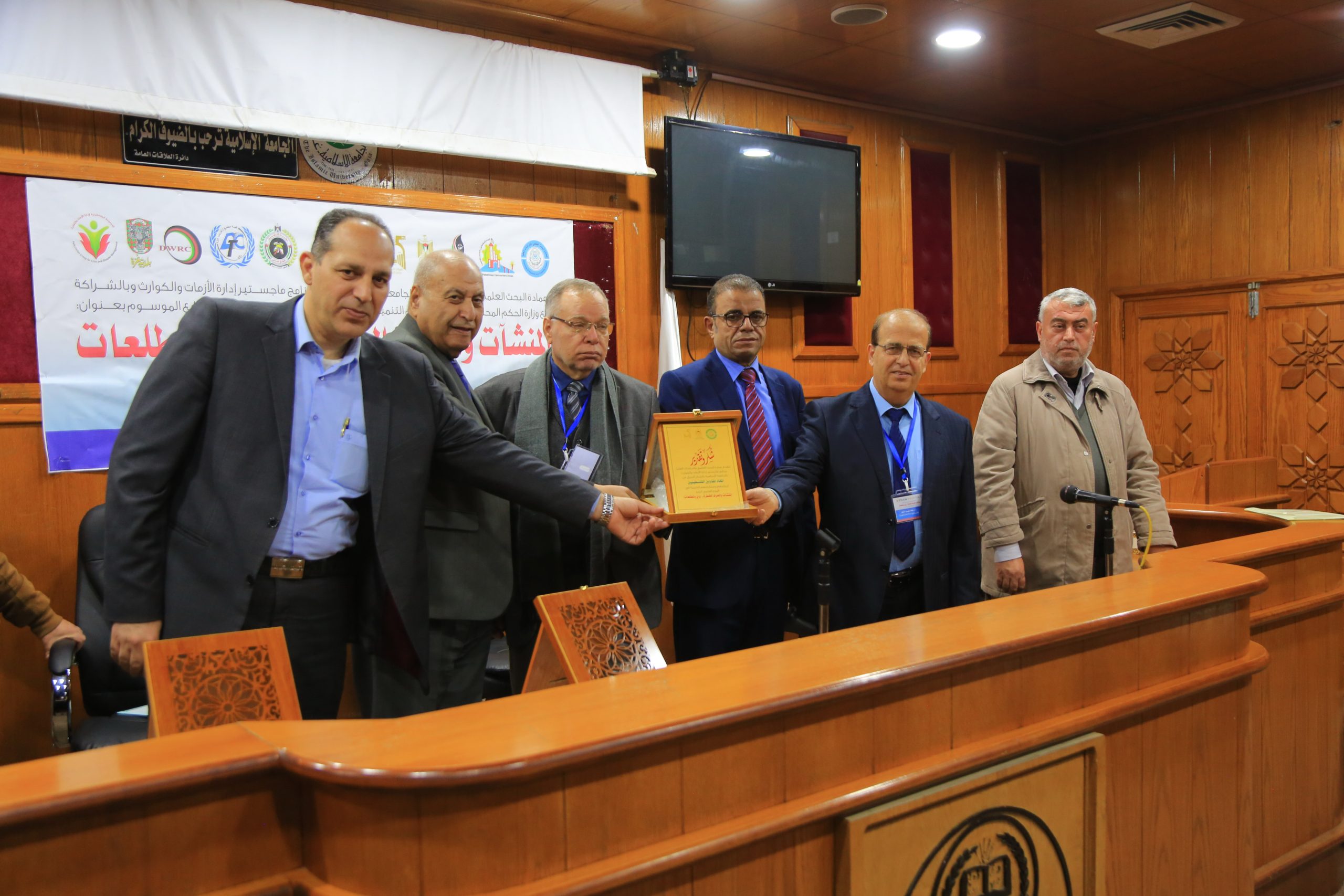
The Deanship of Scientific Research and Postgraduate Studies, in collaboration with the Master’s Program in Crisis and Disaster Management at the Islamic University of Gaza, organized a symposium titled “Hazardous Facilities and Crafts: Perspectives and Aspirations,” which was generously funded by the Palestinian Contractors Union and the National Association of Moderation Development, NAMA. The event was attended by distinguished scholars and representatives, including Prof. Dr. Nazem Al-Ashqar – Deputy Dean of Scientific Research and Postgraduate Studies, Prof. Dr. Mohammed Al-Agha – Chairman of the symposium, Engineer Mohammed Al-Kahlout – representing the Ministry of Local Government, Mr. Mohammed Al-Farra – Vice Chairman of the Government Work Follow-up Committee, along with several academics, researchers, and students.
The objective of this scientific gathering was to address the negative impacts of rapid technological advancements, which have increased the risks faced by workers and craftsmen in factories and facilities. The symposium aimed to explore the various sources and factors that escalate the likelihood of accidents and to channel scientific research towards effective safety and security management in these settings.
Opening session
During the inaugural session of the event, Prof. Dr. Al-Ashqar emphasized the significance of the risks encountered by workers in industrial facilities and called upon the responsible institutions to uphold measures that mitigate these risks. Such measures may include implementing regulatory laws for the work environment, raising awareness among workers and facility owners to prevent hazardous accidents, following preventive measures, and enhancing the readiness of factories and facilities with safety devices.
Prof. Dr. Al-Agha underscored the importance of human security, which is based on the philosophy of crisis management. It focuses on working in complex, volatile, and vague environments in a strenuous attempt to explore, penetrate, and transform them into friendly and safe work environments. He explained that the foundation of crisis and disaster management is to prepare for future challenges and create solutions for all potential problems. He added that the Islamic University is constantly seeking to develop and equip its students with new information in the world of crisis management and future solutions to environmental problems.
Engineer Al-Kahlout presented the Ministry of Local Government’s strategy to reduce the risks associated with work accidents, which included monitoring hazardous crafts, appointing a security and safety committee to oversee them, issuing administrative decisions that mandate the closure of facilities that breach applicable regulations, and establishing a government committee to develop systems that comply with international occupational safety standards, which can be applied in the Palestinian context.
Prof. Al-Farra highlighted the need for integration between government institutions and academic establishments, achieved by conducting scientific studies and research provided by educational institutions as solutions for executive bodies.
First session
The academic day comprised three scientific sessions. The first session, titled “Laws and Legislation,” was chaired by Dr. Sabah Abu Sharakh. The session featured scientific papers presented by Dr. Ramadan Al-Agha, who discussed “Threat Management in Facilities and Hazardous Crafts and its Relationship to National Security,” Dr. Marwan Al-Tebi, who presented a research paper titled “The Status of Safety and Security in the Construction Sector,” and Engineer Abdul Fattah Hamad, who discussed “Occupational Diseases in the Palestinian Labor Law.” Mr. Ali Al-Jarjawi concluded the session with a presentation on modern international trends in managing hazardous facilities and crafts.
Second session
The second scientific session, titled “The Status of Hazardous Facilities,” was led by Dr. Abd Al-Shukri. The session featured scientific papers presented by Mr. Abdul Hakim Bashir, who discussed the status of the liquefied petroleum gas supply chain in the Gaza Strip; Engineer Naeem Al-Louh, who presented a research paper on the status of gas stations in the Gaza Strip and corrective measures; Mr. Ramzi Abu Ali, who presented a scientific paper titled “Risks of Hazardous Facilities and Crafts Threatening the Home Front in Gaza;” Engineer Rushdi Khalaf, who discussed the evaluation of safety and security procedures in bakeries; and Engineer Bassam Al-Attar, who presented a case study on a liquefied petroleum gas station adjacent to a liquid fuel (benzene, diesel, and kerosene) station.
Third session
The third and concluding scientific session of the symposium was titled “Awareness and Prevention” and was led by Dr. Jamil Al-Agha. The session featured scientific papers presented by distinguished professionals in the field. Mr. Mohammed Shireer presented his meticulous research paper that evaluated the effectiveness of virtual exercises in hazardous facilities. Mr. Manar Abu Samra presented a scientific paper titled “Safety Requirements for Hazardous Facilities and Crafts,”. Researcher Ms. Alaa Abu Zeid’s contribution to the session was a discussion on the impact of training programs in reducing work accidents and injuries for the electricity distribution company in the Gaza governorates. Ms. Mona Al-Saud enlightened the audience with her review of the classifications of hazardous crafts and licensing requirements. In a final contribution to the session, Engineer Raed Abu Shahla shed light on the extent of awareness of production parties regarding the articles of the Palestinian labor law that regulate work injuries in a practical case study of the bakery sector.
The symposium was an opportunity to discuss and explore solutions to problems related to managing hazardous facilities and crafts. The event emphasized the importance of integration between government institutions and academic institutions through conducting scientific studies and research provided by educational institutions as solutions to problems for executive bodies.
