
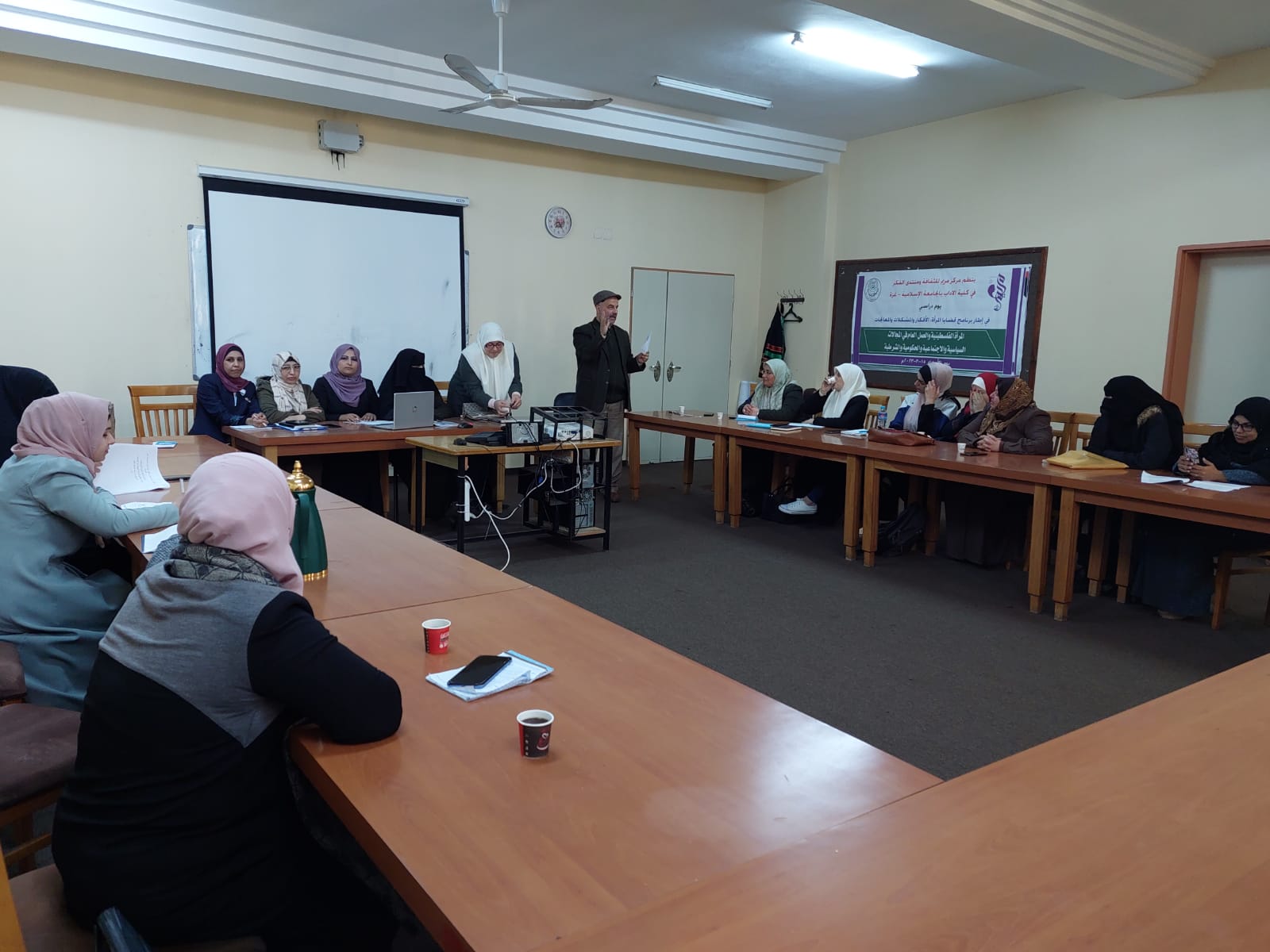
The Forum for Thought in the Faculty of Arts at the Islamic University, in partnership with the Maryam Center for Culture, recently held a seminar entitled “Palestinian Women and Public Work in Political, Social, and Governmental Fields.” The event was part of the program “Women’s Issues: Ideas, Problems, and Solutions.”
The opening session featured Ms. Islam Abdel-Jawad, head of the Women’s Issues Department at the Ministry of Social Development, who discussed the limited participation of Palestinian women in leadership positions in the government sector. Despite the significant progress made by Palestinian women in obtaining academic degrees and qualifications, only 14% hold positions of director general or higher, compared to 86% for men.
Isra Azam, a trainer in disaster and crisis management, conducted a study on the participation of Palestinian women in civil society institutions. Her findings showed that there is limited activity for Palestinian women within these institutions.
Ms. Iman Nakhala, head of the Women’s Power Department in Political and Military Work, praised the heroic role of women in military work against the occupation. She named several female activists who participated in field work, demonstrations, protests, and struggles inside and outside Palestine.
Women’s rights activist Warda Radwan spoke about the prominent role achieved by women in political party frameworks despite their weak representation, which does not exceed 10% according to central statistics.
In the second session, social activist Hayat Abu Al-Amreen discussed the various forms of violence resulting from armed conflicts against women, particularly sexual violence in all its forms. She explained that the demolition of homes, displacement, settler attacks, and repeated wars have had a negative impact primarily on the physical and psychological health of women.
Finally, Khadija Nasrallah, a volunteer at the Daleel Alahrar Center for Strategic Studies, spoke about laws and agreements that protect women in conflict zones. She highlighted the special protection provided against sexual violence and the general protection provided for their personalities and rights.
Overall, the study day shed light on the limited participation of Palestinian women in various fields and highlighted the need for more inclusive policies and programs to address these issues.
