

The Islamic University’s Faculty of Arts and the Maryam Center for Culture collaborated to host a seminar on violence against women in Palestine. The event, titled “Violence against Women: Describing the Problem in the Palestinian Reality and Developing Supportive Treatments for Women’s Justice and Community Cohesion”, was part of a program on women’s issues.
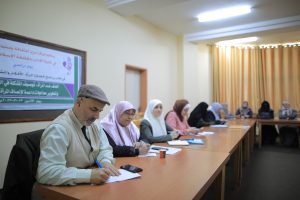
First session
Ms. Faten Harb, a researcher on violence against women, stressed the need for society to acknowledge the importance of women as a key factor for social progress and a bridge to overcome the culture of silence and fear that denies women their rights. Harb noted that Palestinian women suffer from discrimination and violence in different ways more than other women in the Arab and Islamic world. This is mainly because they are trapped by the Israeli occupation and also because of other economic and social problems. The researcher listed the types of violence inflicted on women, emphasizing that psychological violence is the most prevalent. As per the data from the Palestinian Central Bureau of Statistics for 2022, the rate of psychologically abused women in Gaza Strip was 70.7% and 57.2% in West Bank.
Meanwhile, Ms. Mai Atiya, a psychological and educational researcher, found out from a study she did on four abused cases that there are different types of violence, among which psychological violence is the most notorious as it is harder to spot it, along with physical, material, and social violence. Atiya also highlighted the issue of physical and verbal harassment that working women face from men or women, and the issue of online blackmail that leads to suicidal thoughts in many cases.
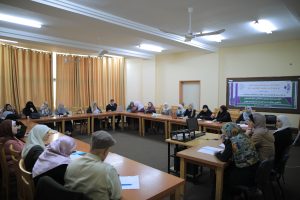
Second session
Ms. Hanadi Skaik, the head of the Consultations Unit at the Maryam Center, blamed the violence on bad inherited habits and traditions, wrong interpretations of religious texts, and Western ideas that are alien to society. Skaik said that the solution to this problem is in awareness-raising campaigns and the implementation of existing laws and regulations to protect women’s rights and punish the offenders of violence. She also said that 83% of the causes of violence were due to poor initial choices, and 85% of the reasons were a result of poverty, debt, and heavy financial burdens. Lastly, the mental health specialist, Ms. Fatima Helles, stressed that violence is a harmful phenomenon for family life, and talked about some legal steps to prevent this phenomenon.
The event provided important insights into the reality and development of treatments for violence against women in Palestine. It shed light on the various forms of violence faced by women and emphasized the importance of taking legal and social measures to protect their rights and prosecute perpetrators of violence.
