
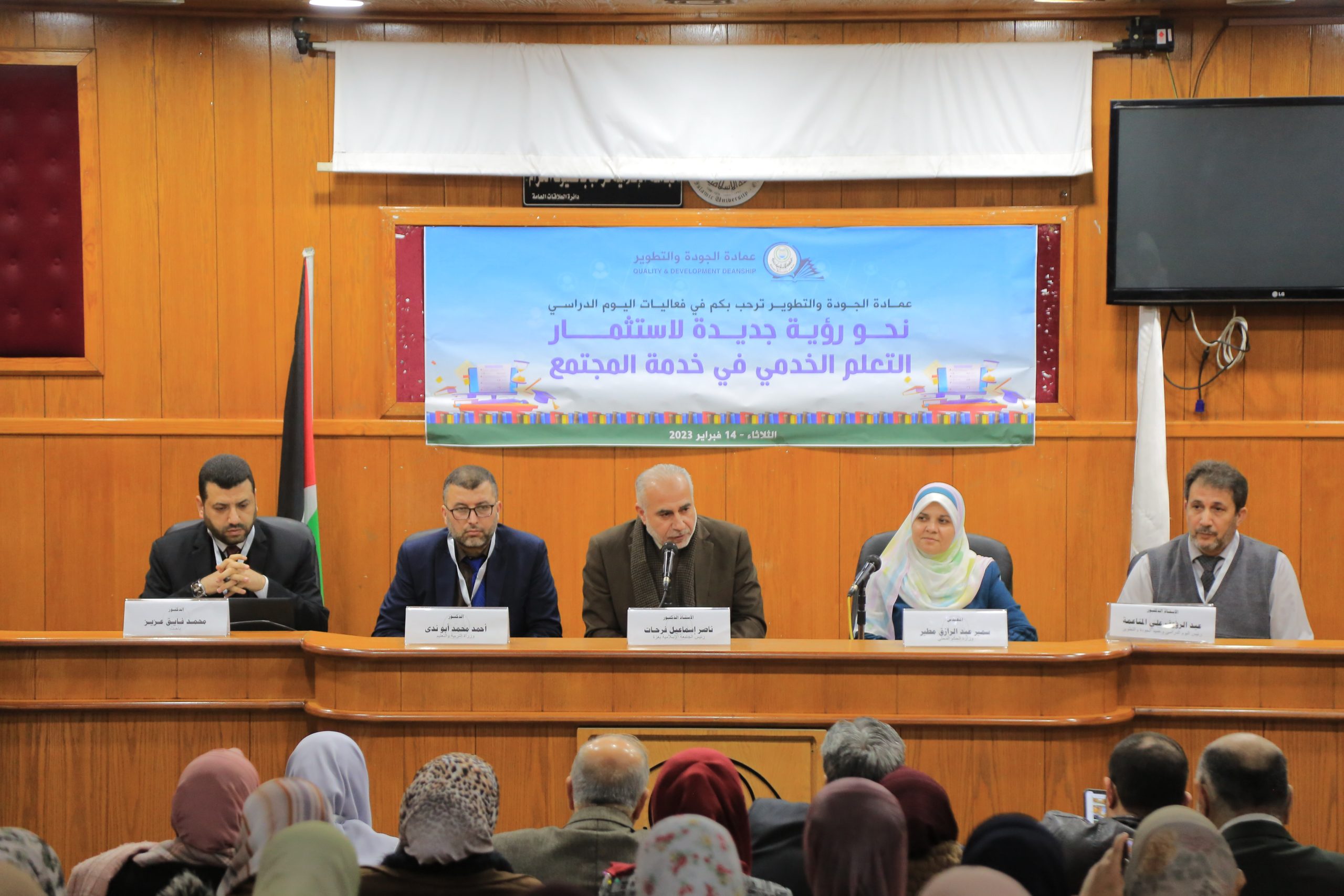
The Quality and Development Deanship at the Islamic University of Gaza recently hosted a seminar centered on the theme of “Towards a New Vision for Incorporating Service Learning into Community Service.” The event was attended by several prominent figures, including Prof. Dr. Nasser Farhat, IUG President; Prof. Dr. Abdelraouf Elmanama, Dean of Quality and Development; Dr. Ahmed Abu Nada, Assistant Deputy Minister of Education and Higher Education; and Eng. Mona Skaik, representative of the Ministry of Local Government.
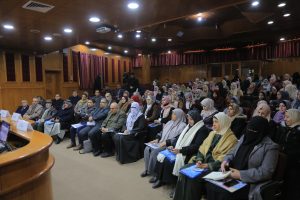
The seminar aimed to explore the potential benefits of service learning for students and the community, highlighting the importance of engaging with social and educational problems to find appropriate solutions. The speakers discussed the impact of service learning on students’ academic and practical performance, and their ability to understand the needs of the community.
The opening session
During the opening session, Prof. Farhat emphasized the importance of service learning in enhancing student participation in the local community, and underlined the university’s efforts to integrate its students into various operational departments across different ministries and workplaces.
Prof. Elmanama also stressed the significance of service learning and its integration into the university’s plans, due to its significant influence on the academic and practical performance of students and addressing the requirements of the community, as well as its capacity to connect teachers and students to the actual world beyond academic knowledge.
Dr. Abu Nada elaborated on how the ministry utilizes service learning to instill citizenship values in students by engaging them in volunteer work, scout camps, and integrating them into professional fields that are significant to the community.
Regarding the level of municipalities, Engineer Skik highlighted the significance of integrating academic knowledge gained from universities with practical experience from local government institutions to produce competent and skilled graduates capable of performing demanding tasks.
The seminar consisted of two scientific sessions, during which a number of researchers presented their findings on the subject of service learning.
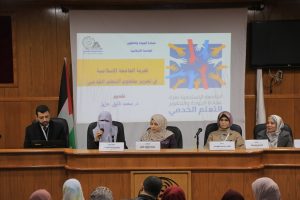
The first session
The initial meeting involved talks on different subjects, such as the university’s initiatives for advancing service learning, how the Ministry of Local Government supports service learning, the application of action research to solve educational difficulties, and how service learning contributes to fostering citizenship values among students at the Islamic University.
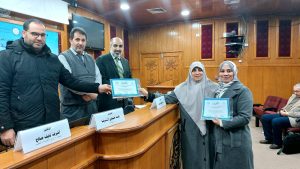
The second session
During the second session, various topics were discussed, including practical education and field training in higher education institutions from the perspective of teaching students. The Ministry of Health’s experience in integrating university graduates into providing community services in university facilities was also explored. Moreover, the session covered the service learning experience in the diagnostic microbiology course, an initiative to explain the Toontastic interactive program, and the experience of service learning in the field of physical therapy for the Principles of Rehabilitation Science course, specifically on the topic of text neck syndrome.
Overall, the seminar presented a new vision for incorporating service learning to serve the community, emphasizing the importance of integrating academic knowledge with practical experience to prepare students for the challenges of the real world.
