

Participants and researchers recommended the necessity of diversifying the use of journalistic formats when tackling issues of Palestinian society in digital media. On the issues of women and the environment, they indicated working to enact a deterrent law for anyone who commits a crime of assaulting women, conducting public awareness and education campaigns, and strengthening the capabilities of environmental media through specialized courses. This is in addition to developing an environmental strategy involving the Palestinian media with a comprehensive analysis of these issues.
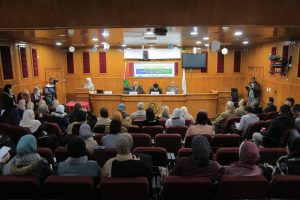
These recommendations came during a seminar held by the Department of Journalism and Media in the Faculty of Arts at the Islamic University of Gaza, under the title “Digital Media and Palestinian Society: Issues between Reality and Aspiration,” in the presence of: Dr. Osama Hammad, Dean of the Faculty of Arts; Dr. Wael Al-Manama, Head of the Journalism and Media Department; and Prof. Dr. Jawad Al-Dalu, Professor of Media, and a group of faculty members and students of the department.
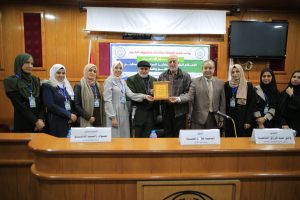
Opening session
In his speech before the opening session, Dr. Hammad lauded the seminar subject and said that digital media contributes to supporting the Palestinian cause in all its forms and truthfully conveying the facts. He noted that the media’s mission is to convey the Palestinian people’s suffering to all countries in the world in order to help them attain their rights.
Dr. Al-Manama stated that the seminar was organized by postgraduate students in order to shed light on the various issues presented by digital media and to develop proposals and recommendations to improve them. He indicated that the Journalism and Media Department has always sought, via activities and events, to significantly develop the Palestinian media through the department’s students and provide them with the crucial skills required for good media.
Prof. Dr. Al-Dalu stressed the importance of digital media and its prominent role in its rapid transmission of events and its transcendence of temporal, spatial, regulatory, and linguistic boundaries, given the characteristics it enjoys, indicating that without the media, the grievances of the Palestinian people or the real events that take place on the ground cannot be reached. He emphasized the need for qualified and trained press cadres in the Palestinian media in order to keep up with technological developments.
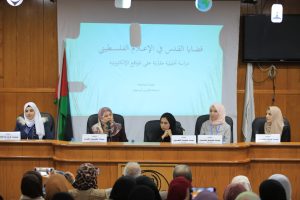
First session
With regard to the scientific sessions of the seminar, it took place over two scientific sessions. The first was chaired by Dr. Mayada Muhanna, a faculty member in the Journalism and Media Department, in which the following working papers were addressed:
- “Jerusalem Issues in the Palestinian Media: A Comparative Analytical Study on Websites,” by Researcher Shaima Abu Muammar.
- “Prisoners’ Issues in the Palestinian Media: A Comparative Analytical Study on Websites,” by Researcher Heba Nabhan.
- “Youth Issues in the Palestinian Media: A Comparative Analytical Study on Websites,” by Researcher Heba Al-Balawi.
- “Children’s Issues in the Palestinian Media: A Comparative Analytical Study on Websites,” by Researcher Rima Al-Qatawi.
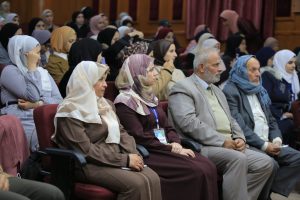
The second session
With regard to the second session, it was chaired by Dr. Raja Abu Mezyad, a faculty member in the Journalism and Media Department, in which the following working papers were addressed:
- “Refugee Issues in the Palestinian Media: A Comparative Analytical Study on Websites,” by researcher Ayat Jadallah.
- “Women’s Issues in the Palestinian Media: A Comparative Analytical Study on Websites,” by researcher Alaa Shobeir.
- “Environmental Issues in the Palestinian Media: A Comparative Analytical Study on Websites,” by researcher Amal Zuhd.
