

The Communicable Diseases Surveillance Center (CDSC) in the Faculty of Health Sciences at the Islamic University, in cooperation with the Ministry of Agriculture, held a workshop on ways to enhance and improve biosecurity on farms and its impact on reducing the use of antimicrobials, with the support of the International Committee of the Red Cross (ICRC) and within the activities of the World Antimicrobial Awareness Week (WAAW).
The opening of the workshop was attended by: His Excellency Dr. Ayman Al-Yazouri, Undersecretary of the Ministry of Agriculture; Prof. Dr. Abdelraouf Elmanama, Coordinator of the WAAW Campaign; Dr. Hassan Azzam, Director General of Veterinary Services; Dr. Robert Porcher, Representative of the ICRC; Ms. Nour Abu Taim, Ms. Rinad Abu Dan, and Ms. Sabreen Abu Zaiter from the Medical Laboratory Sciences Department at the Islamic University.
In his opening speech, His Excellency Dr. Al-Yazouri stressed the importance of cooperation between all institutions and parties to combat this phenomenon and explained that biosecurity measures have a major role in reducing costs and decreasing dependence on medicines, including antibiotics. He expressed the ministry’s desire to move forward with developing biosecurity in the animal production sector.
Prof. Elmanama thanked the Ministry of Agriculture for their keenness to raise awareness on the use of antibiotics and thus reducing the phenomenon of bacterial resistance to these antibiotics. He called for unification of efforts to raise community awareness about this phenomenon and to develop effective strategies and policies for rationalizing the use of antibiotics.
Dr. Azzam addressed the efforts exerted by the Ministry of Agriculture, according to which control is imposed on the use of antibiotics among farmers.
Dr. Porcher explained the role of the ICRC in supporting farmers to raise the level of biosecurity on farms, which leads to reducing the spread of infectious diseases and the use of antibiotics, which results in improving the quality of food for consumers. He pointed out that bacterial resistance to antibiotics is a global and growing problem, and if there is no serious movement to confront it, it is likely that more than ten million people die due to antibiotic-resistant infections by 2050.
Dr. Porcher noted the close cooperation with the Faculty of Health Sciences, explaining the volume of research being conducted by the CDSC with the support of the ICRC.
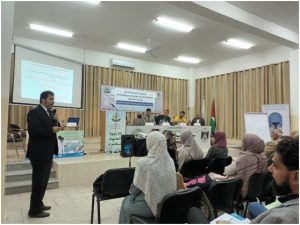
Scientific lectures
The first session opened with a scientific lecture on ways to improve biosecurity on farms, delivered by Prof. Dr. Elmanama, in which he explained the concept of biosecurity and its measures. He stated that the application of these measures limits the entry of infection into the farm, limits its spread among people if infection is found inside the farm, reduces the chances of transmission from one farm to another, reduces the use of antibiotics, and decreases the possibility of residuals being present in poultry meat when consumed. This prevents unwanted access to antibiotics by humans.
Mr. Adham Al-Okshia presented a lecture on the efforts made by the ICRC in supporting a group of broiler chicken farms in the Gaza Strip, aiming to enhance the capabilities of these farms to face climate challenges by improving the farm structure and breeding conditions. He pointed out that some biosecurity measures have positively affected farm productivity and reduced losses, including the consumption of antibiotics.
After that, a session was held to discuss ways to enhance and improve biosecurity on farms, including the role of the government and the private sector in enhancing biosecurity in animal husbandry, how the use of antibiotics can be improved, tools for measurement and evaluation, what are the motives and obstacles to implementation, biosecurity measures that require additional exchange of knowledge, and biosecurity elements in farms that require further experimentation and research.
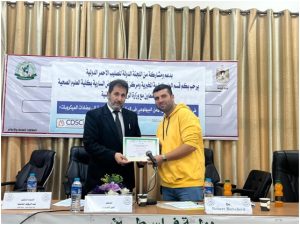
At the end of the workshop, the participants presented their recommendations and discussed them, promising to summarize and circulate them to the relevant authorities. Shields of honor were presented to the Ministry of Agriculture and the ICRC in appreciation of their efforts.
