

The Communicable Diseases Surveillance Center (CDSC), the Faculty of Health Sciences, at the Islamic University of Gaza held a symposium with the participation of students of the master’s program in infection fighting, in cooperation with the American Society for Microbiology (ASM), in conjunction with the International Infection Prevention Week, which runs from October 16–22 of each year.
The symposium was held in the presence of: Dr. Mazen Al-Zaharna, Dean of the Faculty of Health Sciences; Prof. Dr. Abdelraouf Elmanama, Coordinator of the symposium; Dr. Wael Harb, Infection Control Representative at the Ministry of Health; and Dr. Mazen Abu Qamar, Coordinator of the master’s program in infection fighting at Al-Azhar University; and a group of specialists and university students.
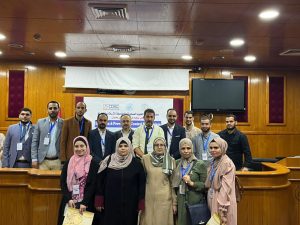
Opening session
In the opening session, Prof. Elmanama called for adopting infection control as a way of life, stressing the importance of involving students in organizing scientific and research activities and commending the contribution offered by the master’s program in infection control. Dr. Al-Zaharna underlined the importance of activating policies that would fight infection and prevent the spread of infectious diseases.
Dr. Harb discussed the dimensions of activating infection control in Gaza hospitals, indicating that the program has had success in several hospitals. Among the achievements of the Infection Control Committee is the preparation of the newly issued National Guide to Infection Control.
Dr. Abu Qamar pointed out the need to adopt infection control behaviors and take them as a way of life, clarifying that the Islamic religion urged us to adopt and adhere to this culture.
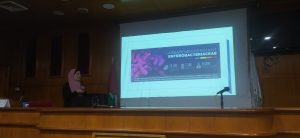
First session
The first session of the symposium was moderated by Mr. Yasser Khalil. The session began with two lectures delivered by Professor Adnan Al-Hindi from Britain via Zoom, where he spoke about the importance of molecular diagnostic techniques in diagnosing and tracing infection. In his second lecture, he invited the audience to join the International Society for Environmental Epidemiology, reviewing the benefits for students when they join educational institutions and specialized scientific societies. The student, Ola Abu Al-Enein, presented research on the extent to which food service employees adhere to the infection control protocol in government hospitals in the Gaza Strip, Palestine. She stated that 56.2% of the participants were from the European Gaza Hospital and 43.8% from the Nasser Complex. The research revealed that the percentage of knowledge of infection control policies among the participants is 54.3%, while the percentage of practicing these policies is 57.1%.
In a lecture delivered by Dr. Abeer Kawaree on infectious disease surveillance in the Gaza Strip, she emphasized that the surveillance process is considered the backbone of infection control and the eye and ear for public health. She reviewed the most common diseases in the Gaza Strip and how to monitor and deal with them when discovered. Ms. Monia Hammouda gave a lecture on carbapenem resistance among gram-negative bacteria, explaining the most prominent ways bacteria use antibiotics and how to detect that in laboratory tests.
The first session was concluded by Mr. Yasser Al-Attar with a lecture on preventing the spread of MRSA through the application of the second level of infection control.
Second session
The second session was moderated by Mr. Muhammad Al-Awawda. It began with a lecture by Ms. Alaa Abed on post-operative wound infection, methods of prevention, control, and prevention policies for this infection used by Médecins Sans Frontières – Belgium. She explained the need to prepare the surgical area by following the recommendations of the WHO about disinfecting the place, removing hair, and using chlorhexidine before the operation.
Ms. Tarneem Al-Nimr presented a study on the importance of adhering to the evidence-based recommendations to combat the infection of surgical wounds in Al-Awda Hospital. The study showed that the percentage of knowledge of control methods reaches 90% and the percentage of practicing these methods is 85%.
The symposium concluded with a presentation of a study delivered by Mr. Abdelrahman Abu Amra and Mr. Mahran Al-Shawaf. The study discussed the evaluation of knowledge and practice of hand hygiene among the nursing staff in the medical intensive care unit at Nasser Medical Complex, Gaza Strip. The two researchers evaluated the hand-washing behavior of the nursing staff before and after a training program on how to wash hands properly. The results showed that the training program of the study sample enhanced and raised the percentage of hand washing in the correct way recommended by the WHO.
At the end of the symposium, Prof. Elmanama addressed the recommendations and honored the participants.
