

The Deanship of Scientific Research and Postgraduate Studies at the Islamic University of Gaza concluded the activities of the Palestinian Scientific Conference for Postgraduate Students 2022 in the presence of Prof. Elyan Al-Holi, Vice President for Academic Affairs, Prof. Ahmed Muhaisen, Vice President for Administrative Affairs; Prof. Youssef Al-Jaish, Dean of Scientific Research and Postgraduate Studies, Dr. Tawfiq Barhoum, Head of the Preparatory Committee; Dr. Bassam Tayeh, Head of the Scientific Committee, and a group of conference participants, members of the administrative and academic bodies; and university students.
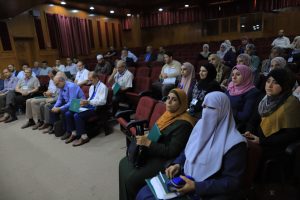
The Palestinian Scientific Conference for Postgraduate Students 2022 was held in six domains and their sessions, and they are:
- The domain of the health sciences.
- The domain of Sharia, Islamic and legal sciences.
- The domain of basic sciences.
- The domain of administrative and economic sciences, as well as crisis and disaster management.
- The domain of the human and social sciences.
- The domain of engineering and technological sciences.
Recommendations from Health Sciences sessions
- Improving the quality of life.
- Developing efforts for patients with heart attacks.
- Developing nursing services in the intensive care departments of government hospitals and primary care centers.
- Providing equipment and resorting to training to address crises and disasters.
- Developing efforts to properly manage medical waste.
Recommendations from Sharia, Islamic and Legal Sciences Sessions
- Collecting and studying the narratives of the predecessors in (interpretation of the Qur’an with the Qur’an) in order to highlight the ways the predecessors benefited from the Qur’an and their approach to that.
- Spreading the culture of hope for victory and empowerment on earth; Which helps in raising the intent and strength of faith.
- Exhausting all possible and available means to protect the weak and preserve their faith, their lives, and their rights in all parts of the world.
- Strengthening the importance of returning to the approach of the Noble Qur’an and the Sunnah of the Prophet in raising generations.
- Calling on institutions and bodies interested in sharia science to adopt, print, and publish books related to serving the people of the Qur’an.
Recommendations from the Basic Science session
- Drawing attention to the use of optical crystals as sensors to detect bacteria and viruses as well as diseases, and the use of metals other than silver as a defective substance in optical crystals.
- Studying the effect of temperature on the properties of the defective layer in optical crystals in the second dimension and the use of semiconductor defective layer during the installation of the photonic crystal.
- Working on research within the scope of nanophysics.
- Communication and cooperation between the Department of Mathematics and the Department of Biology to achieve the best statistically used software other than SPSS.
- Expanding the field of cancer research from the Islamic University Laboratory (INVITRO) to animal models (INVIVO), and then to the level of clinical experiments at the Turkish Friendship Hospital, with the provision of approval and financial support.
Recommendations from Administrative and Economic Science as well as Crisis and Disaster Management sessions
- Preparing financial budgets.
- Training workers to cover the health sector needs of the Big Data and Business program.
- Studying the relationship between middle management and administrative dynamism.
- Activating and publicizing accountability mechanisms in health insurance.
- Putting in place legislation that limits discrimination within institutions.
- Encouraging companies to apply the joint audit approach and working on teaching joint audit in Palestinian universities.
- Adopting the principle of sharing and taking into account the views of citizens.
- Activating the National Center for Crisis and Disaster Management and considering it as a national umbrella for preparing and developing emergency and crisis management in effective scientific ways.
Recommendations from the Human and Social Sciences sessions
- Activating the executive role of educational concerns and developing the professional performance of the educational supervisor through training and workshops, as well as activating the role of the educational supervisor in kindergarten.
- spreading the culture of qualitative assessment among teachers, students, and parents.
- delegating teachers to carry out administrative tasks and involving them in making decisions.
- Urging students to publish in international journals indexed by Scopus
- strengthening the Palestinian curriculum with peaceful cultural foundations in a way that deepens students’ peace.
- Developing specialized research centers for Israeli curricula in order to achieve the educational goals that they instill in their students and refuting their allegations
- Adopting a proposed suggestion to develop the science curriculum in accordance with the global goals for sustainable development 2030.
- Analyzing all curricula to determine the extent of their inclusion and comprehensiveness on TIMSS-2019 standards.
Recommendations from Engineering and Technological Sciences sessions
- Directing research towards the tremendous development in computer engineering, software, and modern technology.
- Searching ways to communicate with the concerned authorities to implement research practically on the ground, especially research concerned with the environment and wastewater treatment.
- Holding joint scientific conferences with local and international universities.
- Motivating young researchers to take part in scientific conferences and allocating incentive prizes for the distinguished among them.
- Applying best practices to improve websites using search engine optimization and providing innovative guidelines for stakeholders to improve websites.
- Adopting advanced security systems when utilizing distributed systems, whether local or cloud-based.
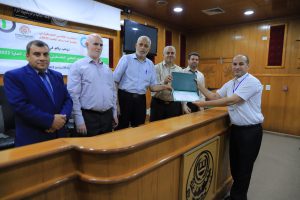
Awards for the best scientific papers and presentations
- In the Health Sciences domain, Dr. Dalal Kamal and her supervisor, Prof. Muhammad Awad, for the papers titled “Integration Between Electronic Medical Records in Governmental Hospitals and Mother.” and ” Childhood e-Registry in Primary Health Care Clinics in Palestine.”
- In the Sharia, Islamic and Legal Sciences domain, Dr. Inshirah Afana and her supervisor, Dr. Abdul Rahman Al-Jamal, for the paper titled: “The Graphic Aesthetics of Identical Verses in Surat Al Imran.”
- In Basic Sciences domain: Mr. Muhammad Al-Aydi, and supervised by Prof. Arwa Ashour, for the paper titled “New generalizations of prime ideals in Lie algebras.”
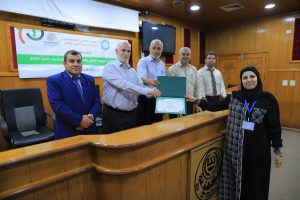
- In Administrative and Economic Sciences and Crisis and Disaster Management: Mr. Saleh Al-Taweel, and his supervisors Prof. Nizam Al-Ashkar, and Prof. Youssef Al-Jaish, for the paper titled: “Occupational Physical Hazard Safety Awareness Level among Healthcare Providers at Shifa Medical Complex in Gaza Strip”
- In Human and Social Sciences domain: Ms. Baraa Adnan Abed and her supervisor, Dr. Elias Nabil Kokali, for the paper titled: “Exploring the causal links between locus of control and job performance among public relations practitioners in the Palestinian government service sector: A pathway analysis.”
- In the Engineering and Technological Sciences domain, Eng. Ahmed Al-Manama and his supervisor, Prof. Hossam Al-Najjar, for the paper entitled: “The effect of seawater desalination for domestic purposes on the reuse of treated effluents in the Gaza Strip.”
