

Psychological Counselling Department of Faculty of Education at Islamic University of Gaza (IUG) held a seminar entitled: “Contributions of Muslim psychologists between past and present”, in the presence of Prof. Dr. Elyan Al-Houli, Vice-President of the University for Academic Affairs, Prof. Dr. Ibrahim Al-Astal, Dean of the Faculty of Education, Dr. Basil Al-Khodari, Chairman of the Preparatory Committee, Head of the Psychological Counseling Department, a group of researchers and interested persons, members of the academic and administrative staff and students of the faculty.
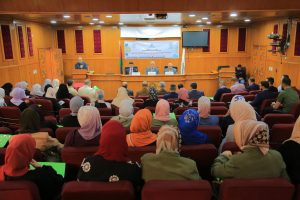
Opening Session
Addressing the opening session, Prof. Dr. Al-Houli said: “Islamic rooting is to highlight the Islamic foundations on which science is based through collecting and deriving them from their rightful sources and general rules and controls, as well as studying them in terms of their topics and curricula, and benefiting from the findings of Muslim scholars in a manner that does not contradict the Islamic foundations”
Prof. Al-Houli explained that the holding of the seminar was in pursuit of IUG mission as an academic institution that seeks to advance scientific, cultural and civilizational aspects, keep abreast with recent trends in higher education and technological development, encourage scientific research, and contribute to building generations within the framework of Islamic values which is in line with one of its goals to root the self-knowledge of the nation.
Prof. Al-Astal indicated that the seminar discusses an important issue related to the Islamic rooting of psychology, which needs more care and attention due to the lack of clarity in some of its sciences and the possibility of entering some impurities and ideologies affecting the faith. He pointed out that the interest in rooting in the past was more evident than the pioneers of rooting.
Dr. Al-Khodari pointed out that psychology is one of the important and indispensable life sciences at various fields. He noted that the Holy Qur’an carries comprehensive contents for the human soul, and that the Prophetic Sunnah contains the founding rules for psychology, guidance and direction, as well as the intellectual legacy left by the Companions and the Followers serves as a base from which scholars can launch the Islamization of psychology.
First Session
The seminar was held over three scientific sessions. The first one was chaired by Prof. Dr. Hamdan Al-Sufi, and the following topics were addressed:
- “Psychological emotions in the Holy Qur’an” by Dr. Khitam Al-Sahar.
- “Human development in Islam” by Dr. Issa Al-Muhtasib and Dr. Mohammed Al-Okor.
- “Contributions of Muslim scholars in psychology in the Abbasid era: Ibn Al-Jawzi as an example through his book “News of the Fools and Simpleminded”” by Dr. Abdul Hamid Al-Farani
- “Stances of positive psychology in the Diwan of Imam Al-Shafei'” by Ms. Aisha Hussein.
Second Session
In the second scientific session, chaired by Dr. Khetam Al-Sahar, the following topics were addressed:
- “Imam Al-Shafei’s contributions to psychological counselling and guidance, analytical study of his autobiography” by Prof. Dr. Abdel Fattah Al-Hamas and Dr. Hamouda Abdel Al-Aal.
- “Abu Zayd Al-Balkhi’s contributions to cognitive and behavioral therapy” by Prof. Osama Al-Muzini.
- “Contributions of ancient and contemporary Muslim psychologists in psychology, counselling and psychotherapy, Ibn Miskawayh as an example of Ancient Scientists and Osman Nagati as an example of Contemporary Scientists” by Dr. Nahed Hararah and Ms. Enas Hararah.
- “Contributions of Muslim psychologists in psychotherapy, Ibn Omran as an example” by Ms. Tasnim Turban.
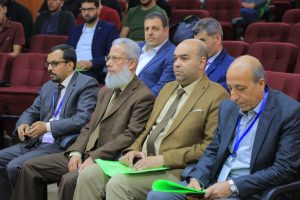
Third Session
In the third scientific session, chaired by Dr. Yahya Al-Abadsa, the following topics were addressed:
- “Islamic Rooting Center: origin and development” by Dr. Basil Al-Khodari.
- “A proposed Islamic vision for psychotherapy from Al-Abadsa viewpoint” by Dr. Tawfiq Shobair.
- “Contributions of Dr. Anwar Al-Abadsa in rooting Psychological Sciences – Scientific Production” by Dr. Shaima Abu Shaaban
- “My experience in psychology” by Dr. Muhammad Al-Astal.
