

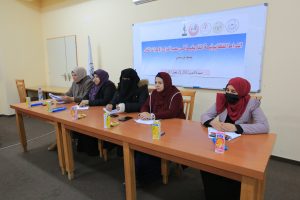
The Cultural Committee of Arabic Language Department, in cooperation with the Cultural Creativity Forum of Faculty of Arts at Islamic University of Gaza (IUG) and Science and Culture Center, held a study day entitled: “Historical Television Drama in the Second Era of States and Emirates”, as part of the activities of (Poetry and Theater Week), in the presence of Dr. Basem Al-Babli – Head of Arabic Language Department, Prof. Dr. Kamal Ghoneim – Head of Cultural Creativity Forum, and a group of academicians, intellectuals and students.
Dr. Al-Babli spoke in the opening session about the importance of scientific studies in the field of drama, because it enriches local artistic movement, and nourishes it with critical observations and recommendations that contribute to its development.
Prof. Dr. Ghoneim explained the concept of scenario and its close relationship with literary studies that keep pace with the developments of our time. He referred to the concept of the second era of states and emirates, which extends since the end of the First World War until today, the era in which modern narrative and dramatic arts appeared, and became the first art of Arabic in our time.
Dr. Wafaa Awadallah, a researcher, discussed in a study “The structure of time in the script of Jamal Al-Din Al-Afghani series by the writer Ahmed Raif”, and shed light on one of the works of historical religious drama, which was able to catch beauty in the structure of time, by controlling the element of time and employing its techniques. Where time paradoxes formed the most prominent elements of the dramatic temporal construction, as the writer penetrate the linearity of time and manipulated its systems. In the scenario, external retrieval increased at the expense of internal retrieval, to reveal the past of an element of the scenario, create a balance between the characters’ past and present, and shed light on some important stations of the course of events. As for the internal retrieval, it did not take the momentum that the external one had, mostly it was a recollection tinged with grief and sadness, in which the characters recall hardships they had gone through.
The researcher Shaima Abu Shakra reviewed in her study “Walid Seif’s nationality and its impact on the series “The Palestinian Alienation””. The researcher concluded the impact of the writer’s Palestinian nationality (Walid Seif) on the artistic construction of his dramatic work (The Palestinian Alienation), where the writer and his family characters were distributed among work characters, like his grandfather Ibrahim, who impersonated the role of Abu Ahmed, and Ibrahim, who impersonated the role of Ahmed, and the writer who impersonated the role of Salah. The study showed that the plots of Alienation were distinguished by continuity because of their realism, the study also confirmed that the story of the series is a complex one that relies on a main story nourished by sub-stories. Walid Seif coordinated between the characters and the method of their dialogues. The method of the educated one differs from the non-educated, and the method of Ahmad Al-Mujahid differs from the method of Al-Mukhtar Abu Ayed.
Doaa Abed’s study addressed “The Employment of Cartoons in TV Dramas: The Movie of Yunus, Peace be upon Him, as a Model,” showing how the writer moved in his cartoon film between the pages of a book, from which the dramatic work emerges in an interesting way that makes the recipient eager to follow the events, as the voice of truth came at a moderate tone at a balanced pace from the beginning of the film to its end. As for the voice of the polytheists, it fluctuated between high and low, and both of them bear significance, the equilibrium on a single tone indicates the truth and lack of fear, while the oscillation indicates lack of honesty and self-confidence. Scenography contributed to revealing the time periods to which the artwork belongs, through visual culture that reflects the scene of events, and what it includes of elements that contribute to the transfer of the written text to the representative visual scenes. Scenography is an artistic tool that uses its aesthetics for artistic purposes, by surprising and fascinating the target audience through the cartoon, which embodied the characters, place and time.
Dr. Sana Zaqout, a researcher, presented in her study “The Mother Character in the Ertugrul Resurrection Series” indicating that the mother’s character in the series played a prominent role in intellectual, ideological and social contexts, which the writer of the historical series intended to employ with its religious, historical and intellectual implications, to present a positive model of the mother in Islamic history. It set an example to be emulated, with its political, military and social functions, and its impact on the course of many historical stations.
The study showed the dimensions of these various characters through the study models: Mother Haima, Sultana Halima, and Mother Saljan, who demonstrated psychological, physical and social dimensions. The study also emphasized the symbolism of the mother in this series, which indicates the inclusive homeland that builds and does not destroy, motivates and does not discourage, advances and does not retreat. It was also a symbol of some mature intellectual, religious and societal values.
The study of Dr. Tahani Abu Salah, a researcher, discussed Abdul Qadir Al-Jilani in contemporary Turkish drama, stressing that several Turkish dramas tackled works aiming at building a spiritual generation by impersonating the characters of scholars, ascetics, reformers and poets such as Ibn Arabi, Bishr Al-Hafi, Yunus Emre and Al-Hassan Al-Basri, Al-Jilani and others who have a conspicuous role in building the knowers.
The study confirms that Sufi cinema in Turkey followed the pattern of social, political, historical or religious cinema, not only with the large number of films which main theme was purely Sufi, but also through the basic transformations that affected the structure of this industry historically since the nineties of the last century until now. It can be divided into two main phases: a phase extending from the beginning of the nineties until the beginning of the twenty-first century, characterized by the production of nearly thirty films that dealt with famous Sufi personalities. The second phase began with the beginning of the third millennium and the arrival of the Justice and Development Party to power, a party that combined in its experience the originality of Islamic ideas and the contemporaneity of political modernity in a new political framework. This phase witnessed the production of a few films compared to the previous phase, but it was a phase that addressed contemporary Sufi themes.
The study day concluded with a set of results and recommendations, which emphasized the need to pay attention to drama because of its significant role in visual documentation and the return of recipients to read history through it, and the need to pay attention to historical cartoon films because they have a positive impact on the behavior of individuals, as they meet the needs of generations, develop their imagination, and construct positive habits and values.
The recommendations also underlined the importance of religious and historical drama, which emerged through the attraction of millions of followers. That is attributed to the nature of individuals, and the fact that it embodies the contemporary history and reality they live in.
The recommendations also indicated the importance of financing Palestinian drama production, and the importance of diversification in Palestinian drama, as it is not required to show the political aspect only, but it can be mixed with other aspects such as issues of people with special needs, women’s issues, or Gaza blockade.