
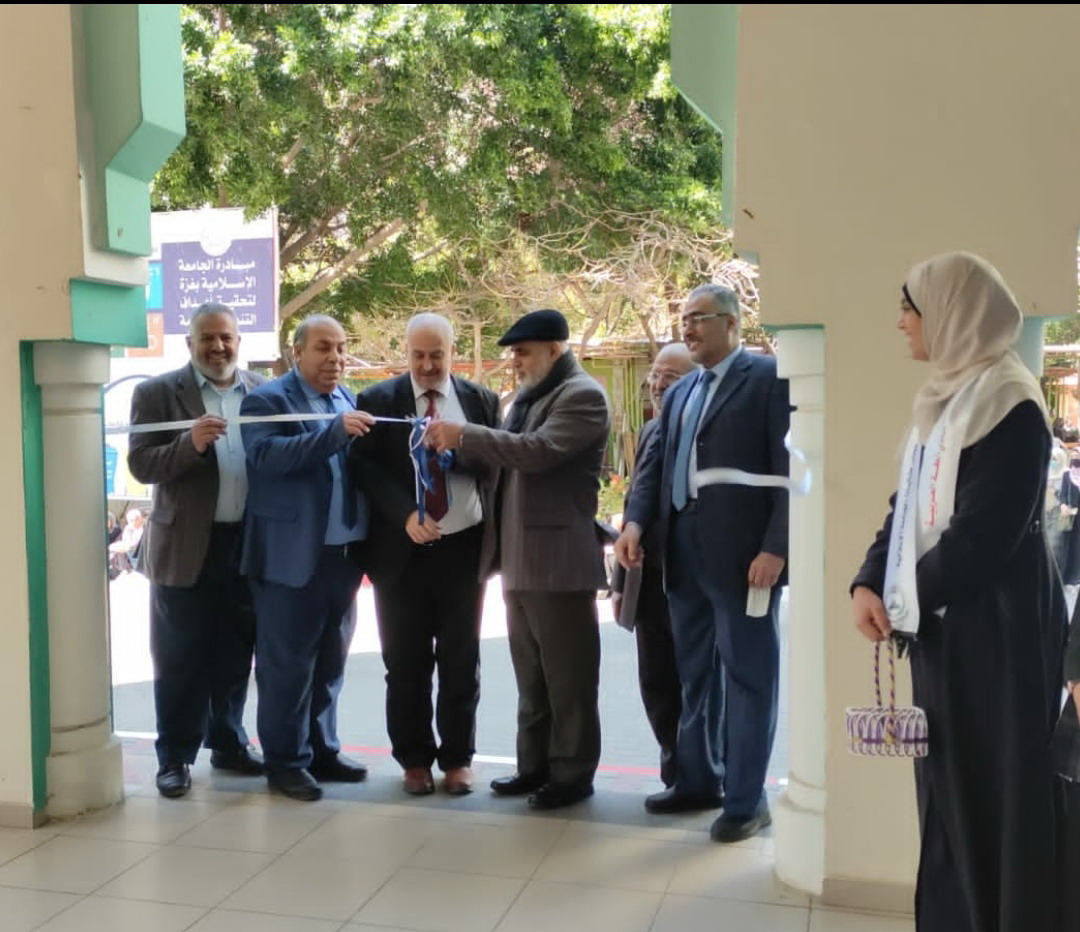
The Cultural Committee of the Arabic Language Department and the Cultural Creativity Forum of Faculty of Arts at Islamic University of Gaza (IUG) inaugurated Book and Authenticated Manuscript Exhibition within the events of Poetry and Theatre Week and Arabic Manuscript Week. The exhibition was held in the presence of Dr. Osama Hamad, Dean of the Faculty of Arts, Dr. Basim Al-Babli, Head of Arabic Language Department, Prof. Kamal Ghonim, President of Cultural Creativity Forum, a number of faculty members, intellectuals and students.

Dr. Hamad emphasized the role of cultural activity in promoting positive change within society, and the importance of printed book and authenticated manuscript in developing creativity and interaction with our cultural roots.
Dr. Al-Babli indicted that our manuscript legacy still needs more efforts to explore its forgotten ingenuity, in order to continuously contribute to cultural life in the time of globalization.

Prof. Ghonim thanked partner institutions for the success of Book and Manuscript Exhibition, stressing that most of book titles were new and had not been shown previously at book fairs, and commended the contribution of authors and publishers in reducing the price of books and supporting them by up to 50%.
It should be noted that the institutions that participated in Book and Manuscript Exhibition are : Arabic Language Club, Centre for Science and Culture, Foundation of Heritage Revival and Creativity Development, Foundation of Eye on Heritage. The exhibition is scheduled to last until the end of March 2022.

Visiting Documentation and Manuscripts Department
In preparation for Arabic Manuscript Week under the slogan “Our Manuscript Legacy in the Time of Globalization”, the Cultural Creativity Forum at the Faculty of Arts held a scientific visit to the Documentation and Manuscripts Department at the Ministry of Awqaf and Religious Affairs. The delegation included: Prof. Kamal Ghonim, Head of Cultural Creativity Forum, and Dr. Anwar Al-Barawi – Member of Cultural Advisory Council.
The delegation was received by Mr. Abdulatif Abu Hashem – Director of Documentation and Manuscripts Department at the Ministry of Awqaf and Religious Affairs.
Mr. Abu Hashem welcomed the delegation, and reviewed the efforts made by the Manuscripts Department in preserving heritage and manuscripts, and indicated that the manuscripts of the Omari Mosque Library are among the most important manuscripts in Palestine, stressing that the library’s inception dates back to (700) years at the hands of Al-Zahir Baybars. It was revived at a later stage in time by the historian of Gaza City, Sheikh Othman Al-Tabbaa. According to what was mentioned in manuscript sources, it contained approximately (20) thousand books. However many of them were lost due to theft and wars, as many of the library’s contents were transferred for libraries in Paris and London during the French campaign and the British mandate, including a large archaeological Qur’an written by one of the scholars of Gaza City, Sheikh Ahmad Shasha’a Al-Alami, and stolen by a British general before Egypt succeeded in returning it to Gaza after nearly 60 years.
Mr. Abu Hashem emphasized that the library is currently rich in hundreds of rare books and manuscripts, and that its titles deal with most of Islamic and life sciences, Arabic literature, rhetoric, medicine, astronomy, history and geography, indicating that the most important of these rare manuscripts is the Diwan of Ibn Zuqa`a Al-Ghazi, who was born in Gaza in the year 724 AH.
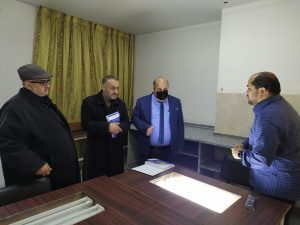
The two sides discussed ways of joint cooperation, and mechanisms for benefiting from the services provided by the Manuscripts Department to the public and partner institutions, in addition to formulating a vision of joint work within that week that establishes an extended scientific relationship.
During their visit, the delegation reviewed the developments of interest in these manuscripts, through the project implemented by the Manuscripts and Antiquities Department at the Ministry of Awqaf and Religious Affairs in cooperation with the University College of Applied Sciences with the support of the Prince Claus Foundation in the Netherlands. The project focuses on three main phases: emergency intervention to restore manuscripts, preparing electronic copies of them, and re-stocking them according to international standards of preserving the age of manuscripts.
At the end of the visit, parties agreed on a series of scientific activities that enhance the knowledge awareness of manuscripts, the mechanisms for preserving them and benefiting from their scientific treasure and the deep-rooted cultural identity.