
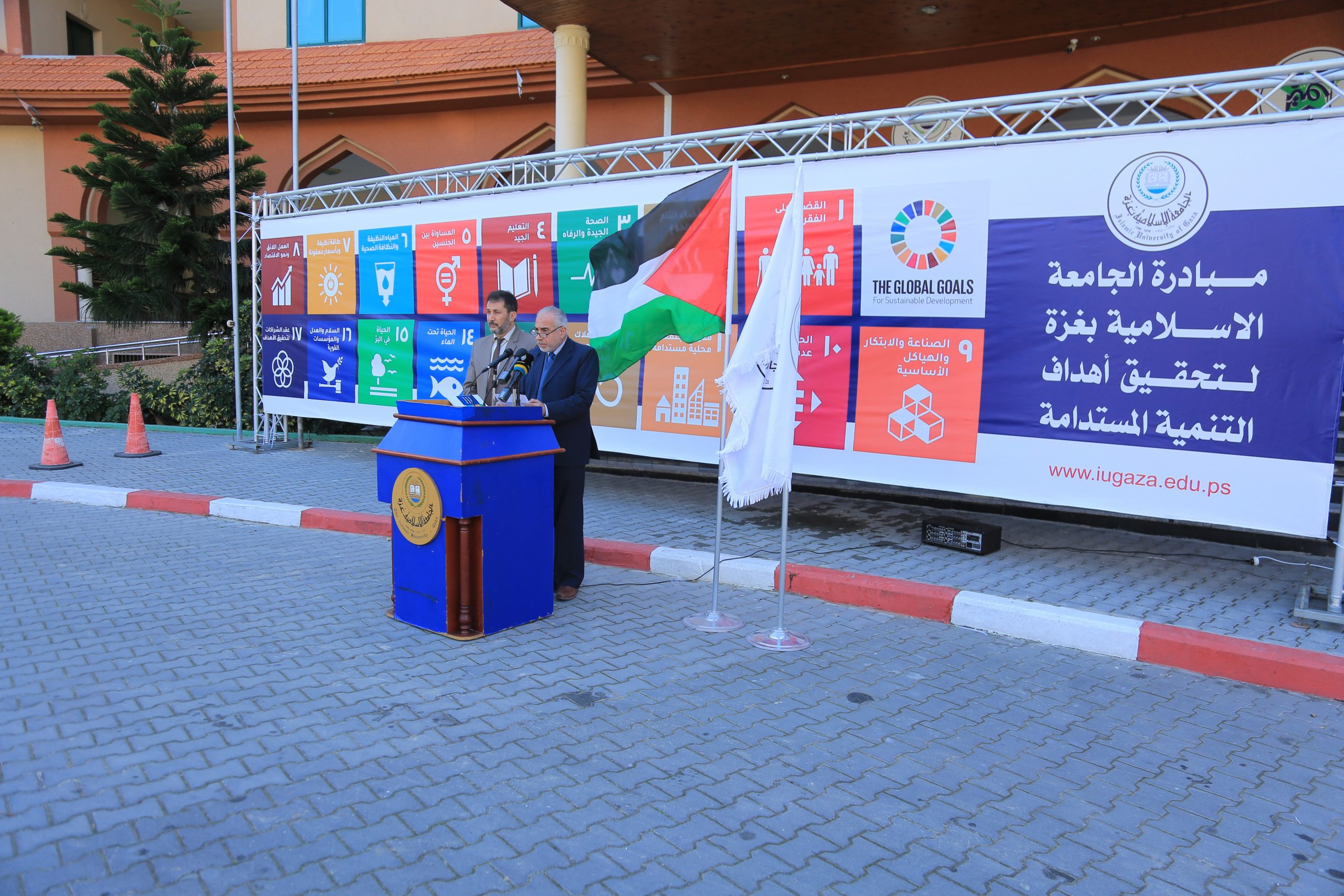
Prof. Dr. Nasser Farhat, President of Islamic University of Gaza (IUG), launched, through a press conference, the “first year of sustainable development”, which comes within the university’s initiative and vision to achieve the sustainable development goals.
University Vision
In his speech during the press conference, Prof. Farhat stressed that IUG has adopted a vision since its inception to be a leading scientific beacon of knowledge, culture and service to humanity in order to attain a comprehensive societal renaissance, and this vision is closely linked to achieving comprehensive development in the Palestinian society and the international community.
Prof. Farhat noted that the international community translated its interest in achieving sustainable development in 2015 by launching the 2030 Agenda, which worked to address all issues that affect life on the planet, and put these issues in the form of seventeen integrated goals (sustainable development goals- SDGs), also known as the Global Goals, as a global call to action to end poverty, protect the planet and ensure that all people enjoy peace and prosperity by 2030, emphasizing that development must balance three main domains: economic growth, social progress, and conservation and protection of the environment.
University Achievements and Sustainable Development
With regard to the university’s achievements in attaining the sustainable development goals, Prof. Dr. Farhat stressed that IUG has great contributions to achieving the various sustainable development goals by adopting the sustainable development criterion in its operational processes, academic programs, research output and community-oriented activities. He continued: “I would like to mention the third goal, which states “promoting good health and well-being for all,” as the university works with its various health programs in the Faculty of Medicine, the Faculty of Nursing, and the Faculty of Health Sciences to provide the community with qualified and trained medical cadres. It also works on spreading culture, conducting solid scientific research, and introducing diploma programs in the same context. Corona pandemic has proven the significance of the universities’ role in strengthening the resilience of society in facing different challenges, especially health ones.
Prof. Farhat added: “As for the university’s contributions to Goal No. (4) of the Sustainable Development Goals, which states to “ensure inclusive, quality, and equitable education and enhance lifelong learning opportunities for all”, the university has worked through its programs in various faculties to prepare and qualify academicians, in addition to the university’s adoption in designing its buildings and programs to integrate persons with disabilities, believing in the right of everyone to access quality education. In the same context, the university works annually to serve students and provide financial assistance to support needy students, especially in light of the difficult economic conditions that the Palestinian people suffer from in the Gaza Strip“.
Regarding the fifth goal, which states “to achieve gender equality and empower all women and girls”, Prof. Farhat stated that the university pays special attention to the promotion of women, which is evident in the enrollment rate of female students at the university, which reaches 59% of the total number of students enrolled. The university also works hard to promote the concepts of women’s rights in society through academic courses, and the university works to employ women in the university according to Palestinian labor laws, in a manner that guarantees dealing on the same salary scale, maternity leave, and various reasons that take into account the different roles of women.
Prof. Farhat said: “The university attaches great importance to preserving the environment, which is addressed by both the sixth and seventh goals of the sustainable development goals through the development of programs and courses that focus on the mechanisms of environmental preservation and management of its components. The academic programs in the bachelor’s, master’s and doctoral degrees in the Faculties of Engineering and Science focus on topics related to clean energy, such as: solar energy, wave energy, water resource management, and other related topics. The university also focuses on its operations depending on the use of environmentally friendly alternatives. The Islamic University has been able to rely in its operational operations on solar energy, and the university aspires to reach 70% of its total energy consumption from solar energy.
Prof. Farhat explained that the university did not neglect the importance of preserving the Palestinian identity by contributing to the achievement of the eleventh goal, which is concerned with “making cities and human settlements inclusive, safe, flexible and sustainable” through its interest in preserving the architectural and oral heritage in Gaza, and contributing to the restoration and operation of archaeological buildings through Iwan Center, in addition to providing community contributions in the field.
Prof. Farhat noted that local, regional and international academic partnerships have always been an essential means to activate the role of the university and find new development areas by transferring experiences and knowledge, promoting cultural exchange to address global societal issues from a Palestinian perspective, and highlighting the university’s role as a primary partner for institutions around the world to achieve development and enhance Palestinian identity and presence despite the siege conditions that limit our international participation and our involvement in knowledge creation circles. However, with the use of modern technology, the university has been able to break the gap, and today the Islamic University celebrates partnerships with more than (350) institutions of higher education and scientific research and community institutions by implementing more than (150) projects to enhance academic and research capacities, and conduct joint research and community service programs. With this achievement, the university meets the seventeenth goal of the sustainable development goals, which focuses on the importance of “concluding local, regional and international partnerships as a means to achieve sustainable development”.
Future Vision
Prof. Farhat concluded his speech by saying: “The university believes in the value and importance of the university’s role in contributing to the achievement of the sustainable development goals through all its activities and operations. To ensure commitment to the implementation of these goals, the strategic plan for the coming period 2024 adopted the sustainable development goals as a primary focus and general umbrella so that they were included in all details and objectives of the strategic plan for the period 2020-2024. We have launched a web page concerned with sustainable development at the university, and currently, we are within the framework of implementing a series of awareness activities within the university campus, and on the university’s page and social media. The implementation of this strategy will be monitored through periodic reports and follow-up committees with the various faculties and deanships at the university. By the end of this year, the university aspires to have tangible contributions to all seventeen sustainability goals with the issuance of sustainability reports for each goal.
From this platform, I invite all students and faculty members to put the vision of sustainable development in mind by implementing activities within a comprehensive development framework.
