
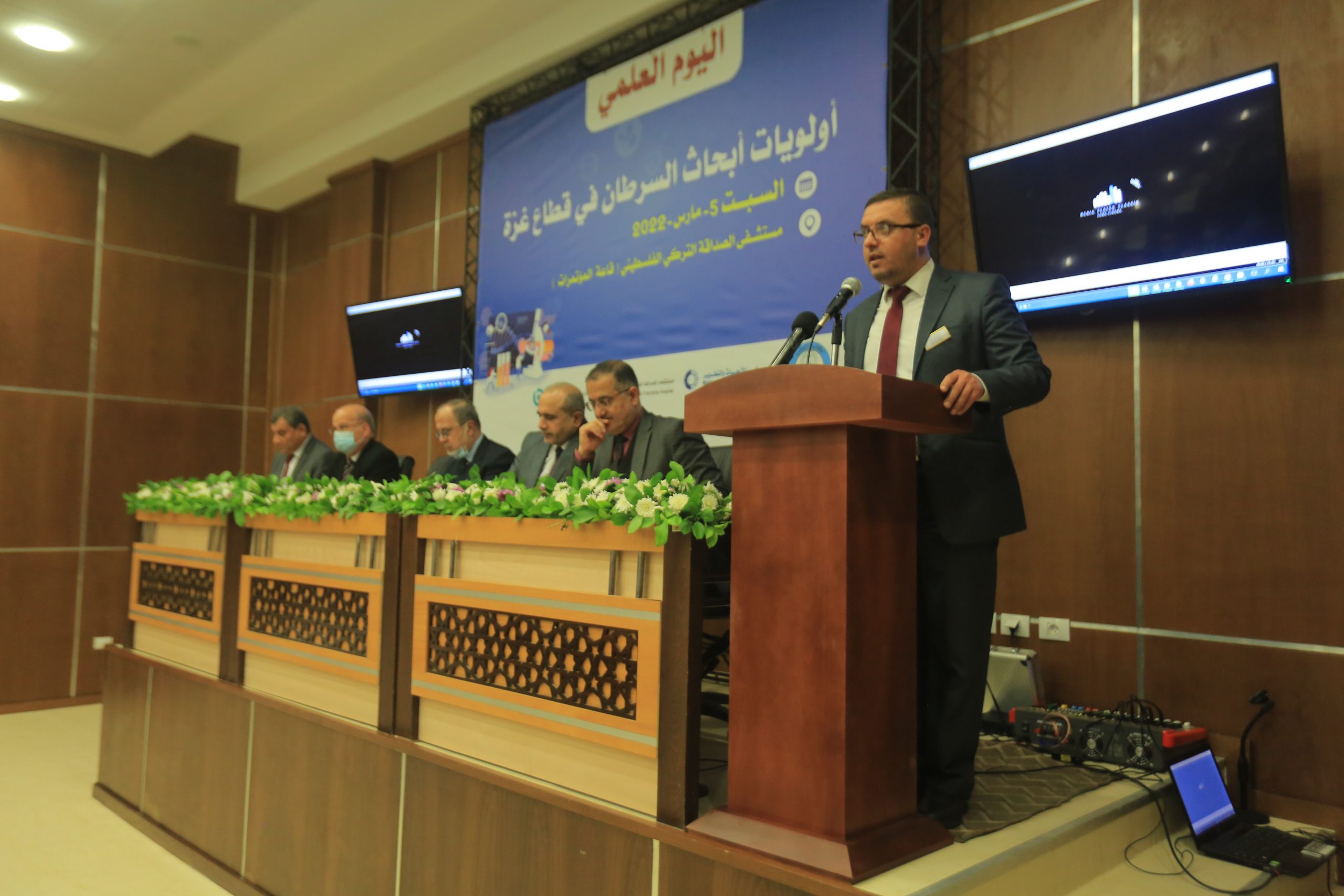
Research and Development Center (R&D Center) at Turkish-Palestinian Friendship Hospital (TPFH), held the first ever scientific day on cancer, entitled: “Cancer research priorities in the Gaza Strip” with a generous donation from Birzeit Pharmaceutical Company.
In three scientific sessions, the researchers reviewed the latest developments in cancer research in the Gaza Strip, and discussed research priorities and ways of developing them based on theories of evidence-based medicine.
The scientific day was attended by representatives from official authorities, representatives of donors and event organizers, doctors, faculty members, medical specialists, researchers, students, and a group of workers in health and medical areas in the Gaza Strip.
The Scientific Committee of the scientific day was chaired by Prof. Saeb Alowaini, faculty member at Biology and Biotechnology Department at IUG, while the Preparatory Committee was chaired by Dr. Sohaib Alhams, a consultant of kidney surgery and urology.
Opening session
Dr. Abdelatif Alhaj, Palestinian Ministry of Health, explained that the ministry seeks to develop and support all components of health work in the institutions of the Gaza Strip, beginning with human resources, governance, infrastructure and research, in order to achieve the eminent goal of providing better service to the patient and developing effective medications that contribute to the treatment and relief of pain.
Dr. Mohammed Alaklouk, TPFH, praised the paramount scientific efforts being exerted to serve an important and vulnerable segment in Gaza, underlying that IUG would devote all kinds of support for speeding development at the hospital’s research center. He said: “We shall place in your hands all capabilities contributing to the development of scientific insights and the achievement of a paradigm shift in scientific research in order to serve neoplastic diseases in Gaza, one of the largest causes of death after heart disease, according to WHO.
Dr. Fadel Naim, Dean of Faculty of Medicine at IUG, stated that this scientific day is the initial of the hospital’s works and the fruit of its cooperation with the Faculty of Medicine, noting that the faculty was the headmost to make noticeable change in the development of medical research in Palestine. That was through conferences and scientific days with experienced foreign universities, which was able to transfer the culture of palliative and clinical medicine as well as rapid medical review to Gaza. He explained that the faculty also conducted (9) scientific conferences, two of which included evidence-based scientific research.
Prof. Yousef Aljaish, Director of R&D Center at TPFH, welcomed attendees and participants, gave an introduction to the hospital’s R&D Center, and presented the departments underlying the Centre’s work, namely Scientific Research Department, Training Department, Community Awareness Promotion Department, and Cancer Registry Department. He clarified that the center is the first of its kind in Palestine to link academic research with applied health, adding that the center is keen to promote pioneering research and support experts and researchers to conduct scientific research that contributes to results based on scientific evidence. He also highlighted that patients being treated in hospitals supporting scientific research were obtaining better and faster treatment results.
Dr. Sobhi Skaik, General Director of TPFH, commended the activities of R&D Center, adding that this scientific day is a result of the hospital’s vision of establishing a national health center as a primary reference point for cancer research within Palestine, and providing an integrated service in one place where all experience was gathered. That should have a positive reflect on the speed of response to treatment, noting that the hospital is keen to support medical performance, which is based on scientific policies and protocols that support evidence-based medical practice with an international academic level that emulate situation in the Gaza Strip.
He said: “We are pleased with the completion of the first phase of the hospital’s strategies for transferring all blood and neoplastic patients from other hospitals in Gaza to ours. We have begun to implement the other stages of providing support services for oncology, in particular surgery and intensive care”. Dr. Skaik concluded by thanking the conference organizers, the donors and the supporters of the hospital.
First session
For scientific sessions of the scientific day, three scientific and research sessions were held, with the first session reviewing three scientific papers, the second session discussing four scientific papers, and the third was a closing workshop devoted to discussion and recommendations.
The first scientific session presented three scientific papers discussing the priorities and challenges of cancer registers. It was chaired by Prof. Yahia Abed, who spoke about the roles, responsibilities and tasks of the Palestinian Cancer Register, highlighting the history and stages of the Cancer Register in Palestine, as well as the mechanism for the standardization of concepts.
In his scientific paper, Dr. Ahmed Alshorafa spoke about cancer in the southern provinces of Palestine during 2015-2019, noting that the number of cancer cases was within normal range in this period.
I his scientific paper, Dr. Khaled Thabet spoke about the latest medication of mobile lung cancer, noting that the real treatment lies in following the technique of cancer cell’s targeting treatment.
Dr. Hossam Hamada concluded the first session by presenting a scientific paper on the goal and mechanism of cancer treatment from a molecular perspective.
Second Session
Dr. Mohamed Abu Nada chaired the second scientific session that included four scientific papers. In his scientific paper, Prof. Nasser Abu Alnour spoke about ways to educate Palestinians about the symptoms of lung cancer, and that the results were based on a national cross-sectional study. Dr. Amal Abu Jameh, in her scientific paper, discussed the clinical effects of cardiovascular diseases and cancer. The paper of Dr. Mazen Alzaharna was on “Detection of colon and rectal tumors through multi-gene DNA analysis of circulating tumors”. Dr. Hanan Abu Kmail concluded the second session by reviewing a scientific paper on Palestinian women’s knowledge of warning signs that suggest cervical cancer.
Closing Workshop
The closing workshop was chaired by Prof Saeb Alowain and involved more than 70 academics and researchers, all of whom collaborated to produce valuable recommendations by answering important cancer questions. Participants were distributed into four groups: the group of oncologists, the group of surgeons, the group of pathologists, and the group of medical and basic sciences.
