

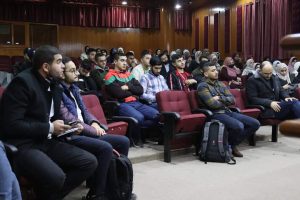
Journalism Department, Faculty of Art at IUG organized a seminar on broadcast production for digital platforms aiming at alleviating the scientific knowledge of students and developing their media performance. The seminar hosted Mr. Saji Alshawa, a specialist in digital audio blogging, to speak about his own experience in broadcast world.
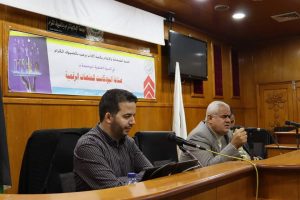
Dr. Amin Wafi, Head of Journalism and Media Department, presented a synopsis of the department and its distinction for adopting the developments in journalism field, and graduating excellent journalists. Adding that, the department seeks to improve students’ abilities through courses and workshops that aim to refine their skills and qualify them to blend in the professional job market.
Dr. Wafi added that, the digital media work today is in need of enormous technological skills that should be known by journalism students in order to bridge the gap between them and the job market requirements. He continued: “the broadcast section is globally and rapidly increasing, it has become a profitable media production source giving the potential of reaching and attracting important clients”.
Mr. Saji Alshawa dived in his personal experience in broadcasting which can be defined as ” video/audio content synchronization via applications that support listening to it through the internet”, and currently it is one of the most famous new digital media tools.
He mentioned that there is one million internationally-registered broadcasting platform, from which (850) thousands are active, including around 50 million uploaded episodes on the internet. In Arab world, however, there is no accurate statistics about the number of real active platforms, but the number of registered broadcasting programs is more than 1400.
He added that, there are more than 5 million listeners of broadcast in Saudi Arabia and 3 million in United Arab Emirates, and there are increasing consideration of broadcasting production in the Arab world by media institutions and production companies.
Mr. Alshawa clarified that, the difference between traditional radio and broadcasting is that “radio transmits its programs to the audience in a specific time, and the listeners have no control of playing them back in contrary to broadcasting. Additionally, the crew of a radio station is abided with producing programs from only the inside, while the crew of a broadcast can do the job from anywhere without limits. Adding that: “the broadcast focuses on exploring specialized, yet not urgent, subjects in contrast with the radio, which sheds light on issues that matter to the listeners in the current time. Besides that, the cost of operating a radio station is high, but broadcasting needs less equipment like a recording device, a computer, and internet access.
Mr. Alshawa explored the types of broadcasting that includes: “solo” or monologue which depends on a single person to present his/her thoughts or opinions regarding the concerned issue, and “dialogic” in which voices are variant by listening to opinions of more than one person. The “dialogic” type focuses on blending between solo and dialogic speech. The third type is dramatic storytelling broadcasting, which considered to be the most influential type on listeners through highlighting the voices of characters, living their experiences and stories, and presenting them in a form of simple deep storytelling.
Regarding the planning of writing a scenario for a broadcast, Mr. Alshawa demonstrated that it begins with “in-depth search of details of the issue in hand, studying characters and guests, determining the course of the text, and writing the scenario”. For how to profit from the broadcast, Mr. Alshawa answered that it can be through commercials or sponsorship. He also illustrated the basics of broadcast production, and programs and tools used. In the seminar, he presented two examples of his own broadcasting, and differentiated between them in terms of strengths and weaknesses.
In conclusion of the seminar, Mr. Alshawa, in personal initiative, offered to grant two students from Digital Media Department the opportunity of practical training on broadcast production.
