
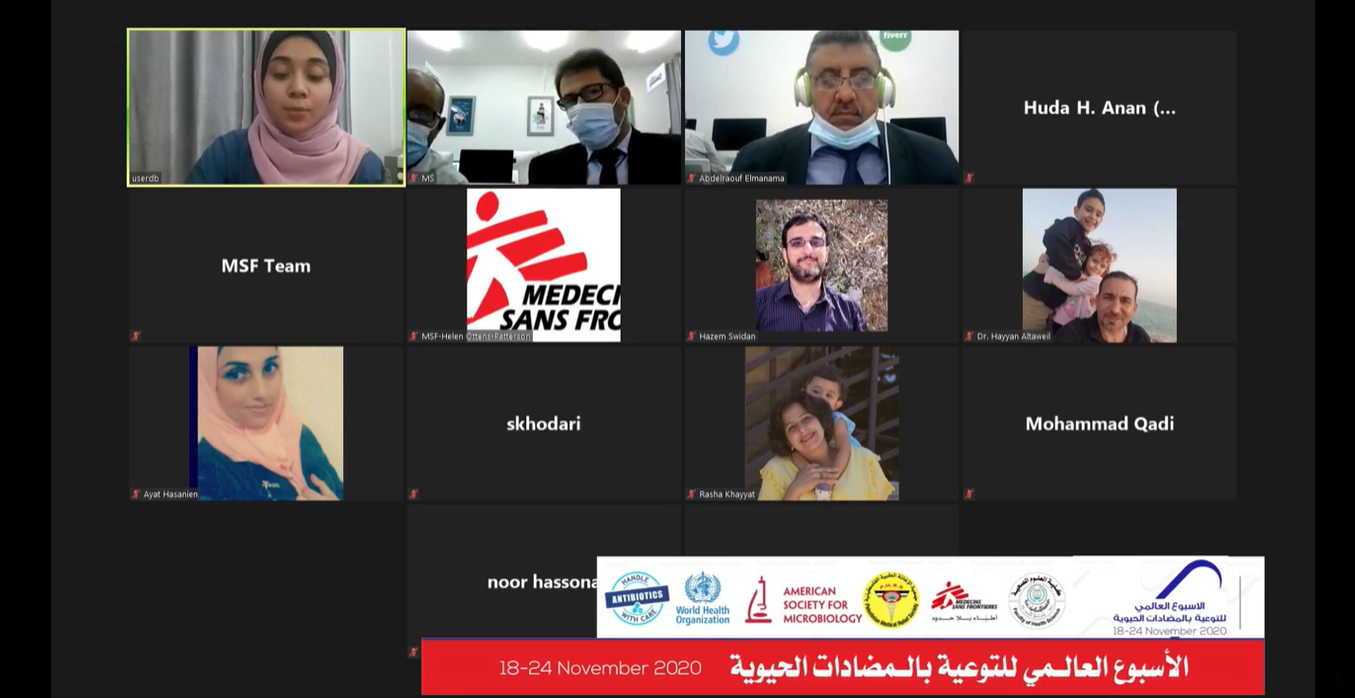
In order to halt any further emergence and spread of drug-resistant infections and with a view to raising awareness about the risk of antimicrobial resistance, the Faculty of Health Sciences at the Islamic University has arranged the annual ASM Symposium carrying a slogan of ” United to Keep Antibiotics” in Saturday the 7th of Nov, 2020.
This Symposium, which was live stream via IUG Facebook account, was launched under the umbrella of the International Week of Antibiotic Awareness Campaign, and with participation of the MSF, WHO, ASM, and the Palestinian Medical Relief Society.
Prof. Abdelraouf Elmanama, who is the coordinator of this Symposium and the ASM Ambassador in Palestine, shed lights on the five chief objectives of this symposium pointing out that the call for this day was mainly to concentrate on the phenomena of bacteria’s resistance to antibiotics. The leading reason for holding the event is to promote community awareness of antibiotics through several cultural activities. The second reason is to collect liable and accurate data from different zones of research and studies. The focal point behind getting the data is to rationalize the overuse of antibiotics in human healthcare, veterinary and agriculture. This will lead to the third objective which is to reduce the rates of infections through abiding to the precautionary measures. The fruitful outcome is to figure out some novel diagnostic paper and drugs.
“The risk of bacteria’s resistance to antibiotics is expectedly exceeding the risk of COVID19 outbreak, as scientists anticipate”, Prof. Elmanama finalized.
Dr. Nabil Alaila, Head of Preparatory Session of this symposium, welcomed the guests and contributors of scientific papers and did explain why antibiotics have been viewed as a matter of concern. He said that the overuse of antibiotics is considered the main factor of the emergence of bacterial strains that are resistant to antibiotics and stole the efficiency of antibiotics. The resistance of these bacteria to antibiotic increases the patients’ possibility of remaining at hospitals for long term because of the affliction of diseases such as pneumonia, TUBERCULOSIS, and blood Poisoning and in turn the costs of treatment will be soaring. the aim of this symposium is to send alarming to the policy makers in order to put a solid national plans to treat the microbial resistance to antibiotics.
The Head of MSF’s mission Dr. Helen Ottens pointed out to the work of Doctors Without Borders foundation in combating the phenomena of bacterial resistance to antibiotics saying that in the coming year, the foundation will establish two microbiology labs in the Gaza Strip to provide high quality results for patients in medical facilities. “The labs will not be enough if the resulted information won’t be used properly,” she recommended.
“WHO is annually keen to launch the activities of the international week for antibiotic awareness, especially the microbial resistance to antibiotic. This phenomenon has brought harm to the public health. The slogan this year is “antimicrobials’ handling with care” to focus on the danger of the microbial resistance to Fungi, antiparasitics and antivirals and antibiotics. The organization concentrated on the principle of ” one health approach” to cover all the risks that threaten the health of human, animal, and environment” as Dr. Huda Anan from WHO office in the Gaza Strip added.
The Head of the Palestinian Medical Relief Society (PMRS) Dr. Aed Yaghi confirmed that over 40 years, his institution as NGO has been in the forefront in the West Bank to rationalize the use of medicines and antibiotics by closely working with the community and with those foundations involved and united in the battle of keeping antibiotics.
First Session
This session included six speakers, in which they displayed some studies on the topic. Dr. Mohammed AlNajjar and Miss Hanan Ramadan presented a paper about the antibiotic stewardship in the surgical and medical treatment of osteomyelitis. In addition, Dr. Nabil el-Aila talked about the molecular characterization of ESBL and MRSA isolates in different hospitals in Gaza. From the West Bank, a paper was introduced by Dr. Mohammad Al Qadie, who explained about the colistin resistance of enterobacteriacae isolated from poultry in the West Bank. Miss Safa Al-Hato’s paper was about the colistin resistance of enterobacteracae isolated from clinical samples in the Gaza Strip. On the other hand, Miss Mariam Al-Reefi shoed her paper which was about the colistin resistance and biofilm formation among Gram negative isolates from poultry. The session was ended by Miss Reem AboShomar paper which focused on the AMR in health care setting.
Second Session
This session comprised of six participants, in which they presented their studies and scientific papers. The session started with Pro. Abdelraouf Elmanama who clarified about the relation between COVID19 and AMR. The second speaker was Prof. Nahed al-Laham who showed some data about the detection and molecular typing of staphylococcus aureus isolated from healthcare workers’ nares at Gaza Strip hospitals. The third speaker was Dr. Rasha Aqel whose paper was about the antimicrobial resistance in post0traumatic osteomyelitis: clinical and microbiological results of protocol-based treatment. The fourth speaker was Mr. Sameh Al khodari whose paper was about the multiple drug resistance among uropathogenes isolates from the Gaza Strip hospitals. The fifth speaker was Mr. Ahmed Al Afifi and he presented about the prevalence of multi-drug resistance bacteria in nosocomial bloodstream infections at the neonatal ICU, Al Nasser pediatric hospital, Gaza, Palestine. The last paper was given by Dr. Suhaila Al-Sheboul whose paper was about the biofilm and antimicrobial resistance of clinical and environmental isolates of pseudomonas aeruginosa.
