
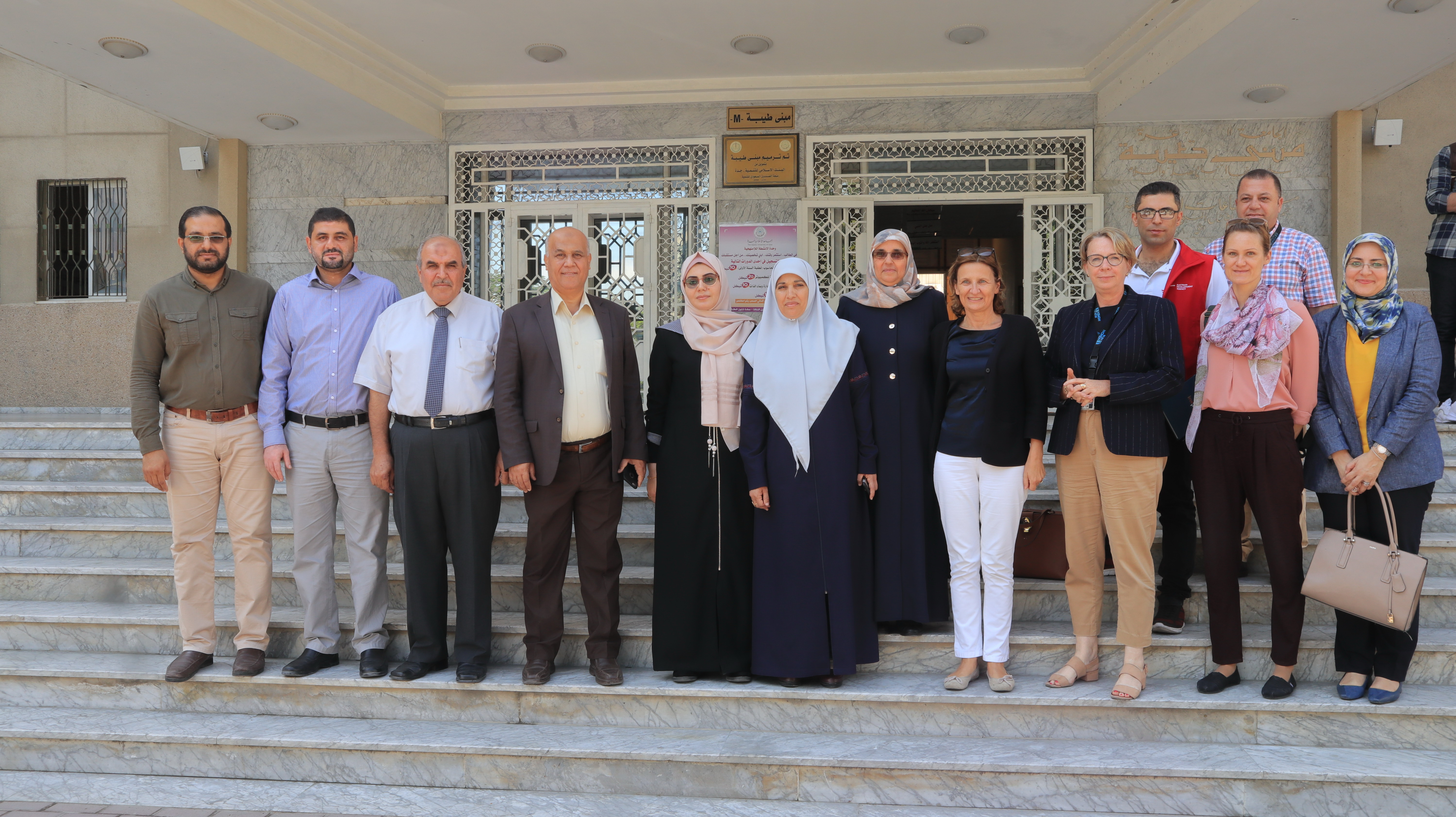
A delegation from the Austrian Development Agency has visited IUG Women’s Studies Center to understand the needs and current interventions regarding the gender equality and women empowerment in Gaza.
The delegation who arrived IUG this morning were: Head of the Austrian Representative Office-Ramallah- Ms. Astrid Wein, Gender and Development Advisor form the Austrian Development Agency Ms. Katrin Fischer who were accompanied by Ms. Heba Zayyan, Head of Gaza sub-office, UN Women Palestine office; Mr. Loai Alhaddad, Gaza Program Manager, Austrian Representative Office; Ms. Maryse Guimond, Special Representative, UN Women Palestine office; in addition to Mr. Abdelrahman Al Assouli, Program Manager, UN Women Palestine office.
Prof. Sanaa Abu Dagga, Director of She Project and Head of Women’s Studies Center, discussed with the Austrian delegation the future plans of the center that were concluded in increasing the awareness about gender equality, doing lectures to local students and to those universities partners in She project, and designing a Research Map that could really support and organize the research process in gender equality instead of individual research.
Eng. Amani Maqadma, Head of External Relations, presented the main center’s objectives and activities which implemented since the establishment of the center, 26 months ago; the activities were varied to include online multidisciplinary courses in Gender Studies, Short-term study visits of IUG staff, international scientific lectures, reforming the curriculum of the course “Human Rights (HR), establishing Women and Gender Studies Centre at IUG, developing a reference library in women’s and gender studies, developing MA programme in Women’s Studies report, translating reference book in the field of Gender, entitled: The Gender: In world perspective, launching a website and training Courses.
Regarding the Human Rights material that the center has developed, Prof. Sanaa said that it is now available for all IUG faculties and can be studied according to three perspectives: Islamic, national and international low.
Ms. Heba added that there is a number of products that study women’s life, mentioning that it is essential to study women’s issues according to Islam since it has actually different related concepts such as Guardianship and Stewardship.
Ms. Katrin Fischer showed her interest in teaching this material from Islamic perspective and requested to know more about this feminist Islamic movements and how the Islamic view reflected in discussions. Commenting on Ms. Fischer speech, Prof. Sanaa confirmed that the principles of International Law are already existed in Islamic Shariaa.
The delegation paid a visit to the Center’s library with a purpose to supplement the library with more womens-related books, as well as, review the diversity of books that deal with women issues.
