
One of the best ways to bring the university reputation up is to bolster the scientific research.
” This Award provokes the academic staffs’ willingness to conduct directed and purposeful scientific research,” declared the Dean of higher studies and scientific research Deanship prof. Mazen Hania.
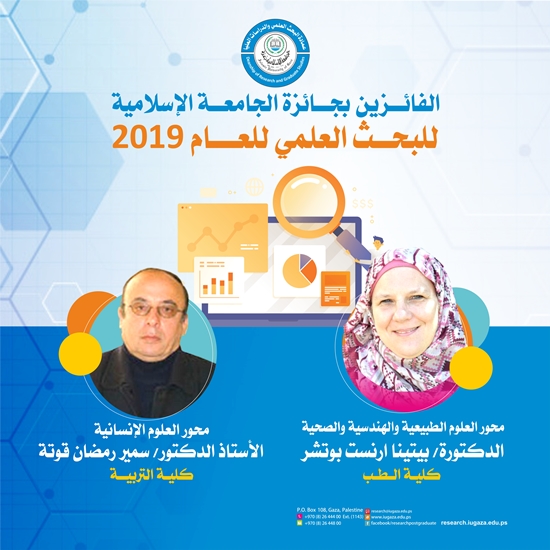
The Deanship of Higher Studies and Scientific Research has announced the winners of best scientific research award 2019, in which the researches must necessarily be published in the International journals indexed in global databases such as Scopus and ISI.
First Award
Prof. Sameer Quta has won the award on his research in the field of trauma which entitled, “The family’s system tendency towards emotional association, and its relationship with the war and the mental health of children and their parents “. it’s worth mentioning that this study has been conducted with international research group consisted of Raija-Leena Punamäki and Kirsi Peltonen.
This research showed that the emotional connection in the Palestinian family is the primary protector of wars’ trauma and the catalyst of mental health and cognitive aspects. This study comes to spot lights on the effective role of the Palestinian family in confronting the wars’ crises. It is to determine the nature of dynamic relationships according to emotional-parental and brotherhood relationship. And how these factors differentiate due to wars’ trauma, as well as, how the mental health and mental processes are affected by family patterns.
The results of the study concluded that the family system is of great influence on children and their mental and psychological health. The Palestinian family has a great ability to give support to their children despite the great pressures the Palestinians under the brunt of wars. The study recommended the necessity to focus on the family and parents during the war time; the treatment must include the family as a whole in the process of therapeutic intervention.
Second Award
The University Award for Natural Sciences, Engineering and Health has given to Prof. Betina Butcher on her research entitled, ” Maternal mortality in the Gaza strip: a look at causes and solution” which was conducted with a research team consisted of Prof. Fadel Naim, Prof. Nasser Abu-El-Noor, Belal Dabour, Yousef ALjeesh. The maternal mortality is an important health indicator for the overall health of a population. This study assessed the causes and contributing factors to maternal mortality that occurred in the Gaza-Strip between July 2014 and June 2015.
This study revealed deficiencies in maternity care, some of which were linked to the socioeconomic situation and the 2014 war. Others show poor implementation of clinical guidelines and lack of professional skills in communication and teamwork. Specialised training should be offered for clinicians in order to improve these aspects. However, the most striking deficiency was the extremely poor documentation, reflecting a lack of awareness among clinicians regarding its importance. Local policymakers should focus on systematic application of quality improvement strategies in order to achieve greater patient safety and further reductions in the maternal mortality rate.
The most striking deficiency was very poor medical documentation which was observed in 17 cases (94%). In addition, poor communication between doctors and women and their families or among healthcare teams was noticed in nine cases (50%). These were repeatedly described by families during interviews. Further aspects surfacing in many interviews were distrust by families towards clinicians and poor understanding of health conditions by women. Other factors included socioeconomic conditions, poor antenatal attendance and the impact of the 2014 war. Low morale among medical staff was expressed by most interviewed clinicians, as well as the fear of being blamed by families and management in case of adverse events. Substandard care and lack of appropriate supervision were also found in some cases.
