
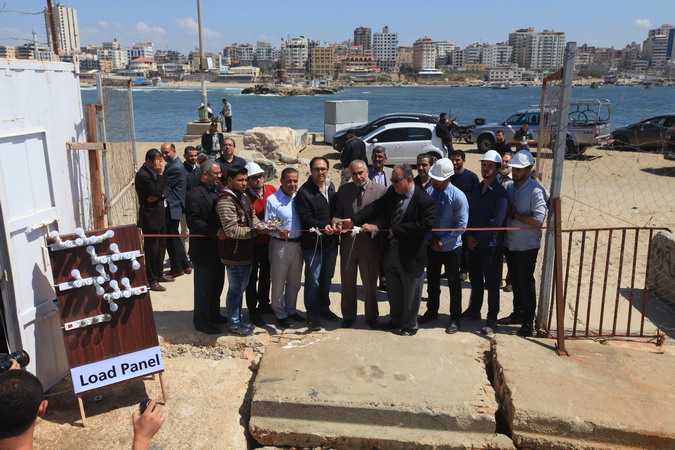
The first of its kind in Palestine. The Islamic University culminates the proposal of a research project with implementation.
On the most suitable location at Gaza shoreline, the President of the Islamic university Prof. Nasser Farahat has recently launched “Wave Energy Conversion System” project to convert the kinetic energy of sea waves into electrical energy. The project has evolved through a research project of IUG engineering students: Eng. Hitham Mushtaha, Eng. Mahmoud Abu Zayed, and Eng. Sami Sbaih.
The launch has been attended by IUG President prof. Nasser Farahat, the Dean of Engineering Faculty prof. Abdel Kareem Mohsen, the Head of industrial and mechanical department prof. Taleb Al-Rayes, the administrator of General Relation department Prof. Saed Al-Namrouti, along with a number of interested personnel in the engineering sector.
During the launch, Prof. Farahat cherished the topnotch potentials of IUG graduates that have contributed in dissolving a number of Gaza crises, especially the sever power cut. He noted that this project breaks out of the womb of hard conditions storming with Gaza, describing the project vital.
Prof. Mohsen said, “one day this project was a dream, and now it comes true thanks to The University and its bright minds”, calling upon donors who value innovations to provide a financial support in order to advance the sustainable development.
In his speech, prof. Mushtaha showed the main components of the converter: a) Floater(s) consists of steel frame and fiberglass liners, b) Arm ((Truss Structures-Hinges), c) Piston(s), d) Fixation base, e) Concrete Platform, f) Hydraulic and Control systems. He clarified the systems that the device works with:
1- Hydraulic (Mechanical) system to convert the kinetic and potential energy of sea waves into electrical energy by moving a floater up and down via the dynamic and buoyant forces of the waves.
2- Control System to maintain the required results and correct errors.
3- Additional Controls to achieve further efficiency in the controlling process.
4- Storm Protection works in emergency cases.
5- Back-to-back Converter to stabilize the output power from the generator and feed it to the grid without fluctuations with steady voltage and frequency.
6- Monitoring System (SCADA) is responsible for controlling and monitoring the system condition.
Eng. Abu Zayed summarized the hindrances that faced them in implanting the project: the lack of practical experiences in the wave energy field, the limited funding needed for the project, and the lack of good equipment. He mentioned that the energy invested could produce in future 10-15 Kilowatt to light 1800 meters from the quay.
Eng. Sbaih thanked the government that has helped them find the suitable location in the shoreline.”The project is a humanitarian and scientific necessary
