
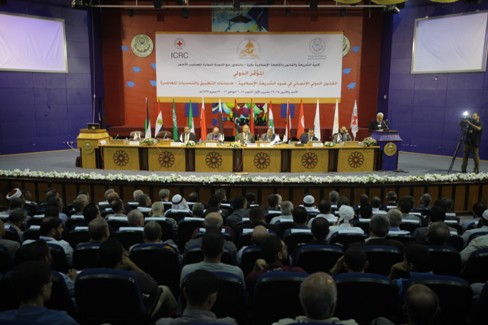
In cooperation with the International Committee of the Red Cross ICRC, the Faculty of Sharia and Law at the Islamic University of Gaza inaugurated Sunday the international conference on the International Humanitarian Law in Light of Islamic Sharia – Implementation, Guarantees and Contemporary Challenges from 25-26 October 2015.

Speaking to a large audience of academics, scholars, students and guests attending the conference, Head of the international committee of ICRC, Mr. Jacques De Maio, emphasized on the fact that the International Humanitarian Law IHL requires global awareness away from embellished speeches and prepared programs and policies. In his speech, Mr. De Maio explained how this conference can work as a chance for the Gaza Strip to convey its message to the world through exposing the occupation’s practices against the Palestinians. He then spoke about how the laws are written to help the Palestinians live a dignified life in times of peace and war, and how they can work to gain their own freedom. He finally highlighted the efforts the ICRC exerts to adapt the International Laws to better suit the Islamic World.

In the opening session, Dr. Adel Awadallah, IUG President, pointed out how the theme of the conference is greatly connected to the message of Islam and the University. He said, “This conference shows how Islam takes extra care of the five essential elements (al-Dharuriyat al-Khams), namely religion (al-Din), life (al-Nafs), intellect (al-Aql), progeny (al-Nasl) and wealth (al-Mal).” He, then, mentioned some verses from the Holy Qur’an which highlight the Prophet’s (Peace Be Upon Him) great morals and attitude that prove how he (PBUH) was the first to set the bases of the principles necessary for humanity and the dignified life of human beings.

Other speakers addressed key issues during the opening session that highlighted the harmony between Islamic Sharia and international law on many issues related to the protection and dignity of human life in times of war and peace. Participating in the two-day conference are 43 researchers from 10 countries including Palestine, Saudi Arabia, Egypt, Qatar, Bahrain, Iraq, Algeria, Lebanon, Tunisia, and Sudan.
