
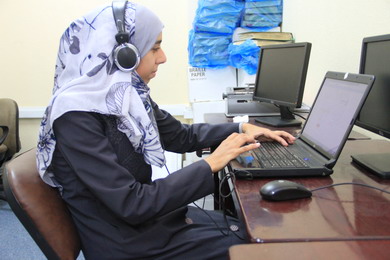
Beneath the shades of blue and rays of yellow, a girl who was, then, on the verge of losing her entire sight sat to write. She could barely see the words, but she knew what she wanted to say and she knew how she wanted to say it.
“The jury did not know I was blind when I first signed up and I had no plans in telling them; however, when they started asking me to show more involvement with the audience and to have eye-contact with them, I had to tell them about my condition and keep on reciting.”
She told us that after the 2014 attack on the Gaza Strip, she and few others held a small party for the children on the wreck of the destroyed homes. They wanted to replace the booms with cheers and laughs. And she did.
Asmaa Abu Shawish, born in Khan Younis, joined UNRWA schools for education and started losing her sight as she grew older. When she was in high school, instead of celebrating her youth, she was announced legally blind.
“Our house was bombarded when I was in the fifth grade. I was overwhelmed with sadness. My heart, so hollow and sorrowful, pushed me to speak up, to write. I wrote for my homeland, for the martyrs, for the children – for the Palestinian rock,” wrote the ten-year-old Asmaa as a first attempt in the world of literature.
As time passed, Asmaa started her journey in writing. She joined a competition when she was in the tenth grade; however, the jury excluded her saying that what she wrote was not poetry. Such news made her unhappy, but she refused to give up on herself and on her pen.
Asmaa joined the department of Arabic language at the Islamic University of Gaza. The beginning of writing metered poetry was after she took ‘Arabic Prosody & Rhyme’ course. Her first poem written using Arabic meter was inspired by the 2012 aggression on the Gaza Strip. “The brutality we saw during that aggression fueled me with the will to write and express myself. It was my first success in poetry,” said she.

She wrote several poems about women, and selected the most appropriate to join the university’s poetry contest ‘The University’s Poet’. Unfortunately, Asmaa did not win the first prize – though she won the second one. “The jury did not know I was blind when I first signed up and I had no plans in telling them; however, when they started asking me to show more involvement with the audience and to have eye-contact with them, I had to tell them about my condition and keep on reciting.”
Asmaa, who is benefiting from a scholarship presented to her by IUG, vividly and cheerfully spoke about her experience in her second year when she received the award of ‘Golden Voice’. “I made use of my previous experience and it encouraged me to move forward. The title made me feel responsible towards it that I knew I had to pay my respect by being a true Golden Voice.”
Asmaa may have lost her sight, but she definitely did not lose her sense of love and care for others. She is an active volunteer who joined different women initiatives which had a great positive impact on her life. She told us that after the 2014 attack on the Gaza Strip, she and few others held a small party for the children on the wreck of the destroyed homes. They wanted to replace the booms with cheers and laughs. And she did.
Her disability was not a hindering obstacle. She refused that it be so. She fought against odds, she challenged her blindness, and she won.
