
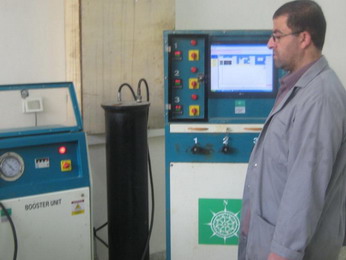
Attacking the laboratories at IUG caused the burial of some of soil and materials laboratories, the thing that affected the society institutions and the students who were using these labs for doing experiments. Despite all of this, the relations between IUG and the national and international establishments contributed to the former going on its academic and scientific march. For instance, the labs did all the hydrological and geotechnical studies necessary for the design of a sewage plant in Khan Younes and its facilities such as: drainage basins, pressure lines, and pumping and injection tests. This was done in collaboration with Arabic and foreign establishments and local engineering offices.
In addition, the labs provided technical support and quality control to poulothelen pipelines, rasterization pipelines and valves that are used for emergent support and reconstructing the agricultural sector. Besides, materials and soil labs did control the quality of squeezed sandy blocks used for the first time for establishing temporary housing units funded by UNRWA. Moreover, the labs helped in doing medical bricks researches.
The labs of engineering and technology building were damaged as a result of shelling the scientific labs building during the last war on the strip, the ting that caused the damage of almost 23 engineering labs. In order to be able to provide students with academic services and the society with societal ones, engineering faculty did its best to open new labs and revive the labs that has been destroyed. For instance, the faculty opened a lab for the architectural department and it was funded by International Muslim Hands Establishment. Opening the lab enhances adopting computerized programs in teaching architecture department courses for BA and master degrees students.
Furthermore, the faculty reopened logical design and dipped systems labs for computer department and they are prepared by researches and projects lab at the faculty. Computer engineering department relies on the two labs in upgrading the overall level of students and improving the quality of the educational march.
Besides, in 2009, the faculty reopened Ewan Center and Arabesque permanent exhibition and they were funded by Prince Claus Dutch foundation for cultural development. The main aim of founding the center and the exhibition is to build a true vivid image of the Palestinian architectural heritage in Gaza Strip and to shed light on its historical importance. Moreover, founding the center and the exhibition aims at conducting researches and introductory studies on the Palestinian heritage through communicating international community institutions. In addition, the center and the exhibition help in producing and marketing traditional artistic works which enhance the cultural values of the architectural heritage in the society.
