
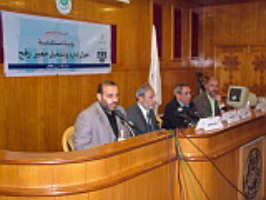
Commerce Faculty at IUG in coordination with Creativity Institution organized a Study Day entitled (A Future Sight on Operating and Managing Rafah Crossing).
Dr. Mahmoud A-Zahar, Palestinian Legislative Council deputy, Dr. Salem Helles, Commerce Faculty Dean, Dr. Muhammed Migdad, Scientific Committee chief for the Study Day, Dr. Muhammed Al-Madhoon, Director of Prime Ministers Office, a group of faculty members, researchers, experts, and interested people, have attended the first session of the Study Day.
Dr. Zahar confirmed that the ceasefire is conditioned of stopping all aspects of aggression against the Palestinian people and breaking the imposed siege including reopening Rafah crossing.
Dr. Zahar added that crossings linked the Palestinian Economy with the occupation economy renewing his rejection to a Europe intervention to be a tool of opening and closing Rafah crossing.
Dr. Helles referred to the importance of reopening Rafah crossing noting that the Study Day aims at studying settings of Rafah crossing work, clarifying the political and economical impacts during crossing management, introducing a conclusive view to operate Rafah crossing.
Dr. Helles explained that the Study Day will include two sessions; the first session tackles the political side while the second will discuss the economic side.
Dr. Al-Madhoon confirmed that there should be a political arrangement before operating and managing Rafah crossing. He considers the economic movement an important step to operate Rafah entrance referring that finding goods in Rafah entrance will make a major change in its work.
Dr. Migdad assured that the Palestinian people depends on the Arab and Islamic world hoping that they will participate in breaking the imposed siege and reopening Rafah crossing.
Dr. Migdad added that closing crossings has affected all aspects of life, including: stopping the work of institutions in many sectors; shortage of fuel supplies; electricity construction materials; and many others.
